Comprehensive Architectural Framework Connecting Modern Infrastructure Pipelines Intelligent Observability And Engineering Teams
What Is XOps?
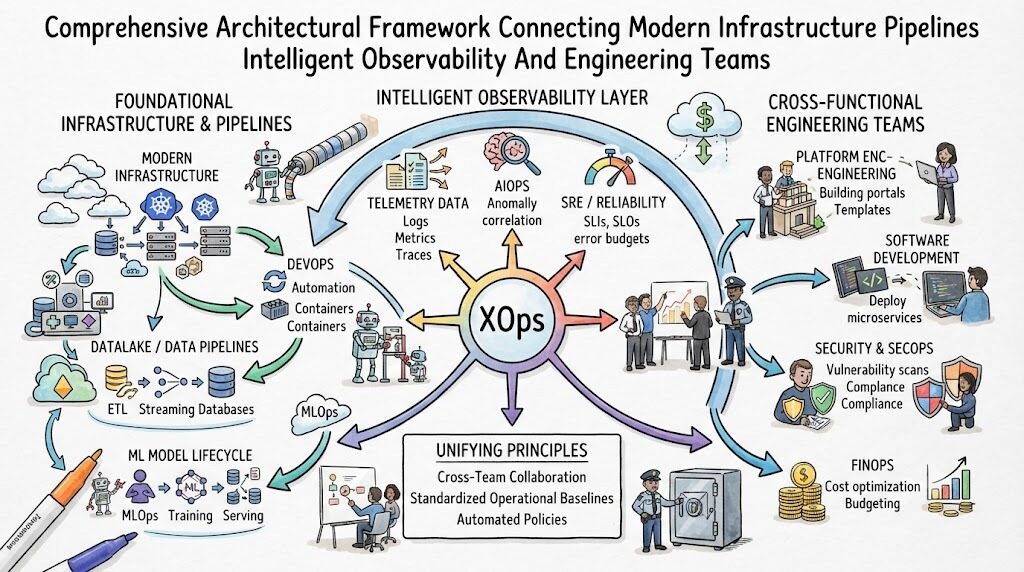
The label XOps represents an expansive engineering philosophy where the prefix "X" denotes any critical operational specialty within the enterprise software lifecycle. Instead of isolating release management, platform health, storage pipelines, machine intelligence, and infrastructure governance into disconnected silos, this overarching model establishes tight operational feedback loops and shared engineering standards across teams. Picture a modern fraud-detection platform: continuous integration engines assemble microservices, automated data workflows ingest transactional events, model operations frameworks retrain neural networks, algorithmic telemetry platforms spot latency anomalies, and cloud governance tools monitor compute consumption. Because every layer depends directly on adjacent components, cross-functional operational standards guarantee that each component functions harmoniously from initial code commit to production runtime.
What Does XOps Include?
Modern software ecosystems merge several distinct operational branches to accelerate feature delivery, secure distributed workloads, and ensure uninterrupted service availability. While each discipline solves unique technical bottlenecks, all branches implement shared baseline principles including declarative code definitions, automated validation test suites, continuous pipeline execution, and pervasive metric collection. The structural comparison below highlights the primary responsibilities and functional targets that define each key operational specialization:
| XOps Discipline | Primary Focus | Typical Responsibilities |
| DevOps | Continuous application delivery | Building deployment pipelines, packaging container images, and executing automated releases |
| DataOps | Data pipeline integrity | Managing ETL transformations, validating schema boundaries, and auditing data provenance |
| MLOps | Machine learning lifecycles | Containerizing predictive models, monitoring feature distribution drift, and managing weights |
| AIOps | Algorithmic telemetry parsing | Isolating metric anomalies, clustering noisy system alarms, and accelerating root-cause analysis |
| SecOps | Continuous security controls | Embedding static vulnerability checks, scanning runtime images, and controlling access secrets |
| FinOps | Cloud economic optimization | Monitoring resource utilization, allocating infrastructure expenses, and tuning instance sizing |
| SRE | Infrastructure availability | Defining service reliability targets, administering error budgets, and leading outage postmortems |
| InfraOps | Base compute management | Orchestrating physical and virtual servers, managing IP routing, and provisioning storage |
| Platform Engineering | Developer productivity | Constructing internal self-service developer consoles and maintaining golden deployment paths |
What Is XOpsSchool?
Engineers and engineering leaders leverage this independent learning community to study how various modern operational disciplines intersect across complex enterprise production landscapes. The educational curriculum walks practitioners through container orchestration mechanisms, declarative infrastructure definitions, distributed telemetry topologies, dynamic data processing pipelines, and autonomous alerting architectures through guided, realistic modules. By focusing on practical, hands-on application scenarios, the educational modules help engineers grasp the operational dependencies that connect clusters, pipeline runners, event buses, and telemetry dashboards into fault-tolerant platforms.
Why Is XOps Important?
Modern distributed applications rely on containerized topologies, event-driven microservices, and massive real-time data streams that completely overwhelm rigid, uncoordinated operational units. When engineers update application services without alerting the data platform team, unannounced payload modifications crash downstream transformation engines, unpatched security vulnerabilities escape into production clusters, and untracked cloud usage triggers unexpected bills. A coordinated operational architecture resolves these problems by enforcing consistent deployment pipelines, centralized observability standards, reproducible infrastructure blueprints, and automated resilience policies across every engineering unit. This collective approach maintains system stability under peak user loads, preserves data fidelity across analytical pipelines, guarantees regulatory adherence, and instills shared ownership across engineering teams.
Why Choose XOps Training?
Pursuing formal operational education helps technical professionals look past single tools and understand end-to-end system architectures across contemporary cloud-native environments. Rather than mastering only one continuous delivery tool or configuration format, engineers acquire practical fluency in distributed telemetry, programmatic infrastructure management, Kubernetes orchestration, machine learning delivery lifecycles, and policy-driven security controls. This comprehensive perspective dramatically enhances cross-team incident triage, eliminates communication barriers between developers and platform administrators, and enables architects to design resilient production systems. Developing competency across multiple adjacent domains produces versatile engineers who can lead complex cloud migrations, standardize company-wide developer platforms, and protect system reliability.
How Does XOps Training Work in Practice?
Effective operational education starts with core Linux system internals, network protocols, interactive shell automation, and collaborative Git branching strategies. Practitioners subsequently package containerized microservices, build multi-stage automated build and release workflows, and orchestrate cloud infrastructure using declarative templates across enterprise cloud platforms. The learning sequence then introduces distributed trace collection, automated security vulnerability scanners, and site reliability engineering practices like automated failover routines and error budget accounting. Moving deeper, learners configure data orchestration pipelines, automate predictive model deployment lifecycles, and implement intelligent alert correlation tools that ingest multi-tier system logs. Solving purposefully introduced environment faults and production-grade pipeline failures develops sharp troubleshooting reflexes that theoretical manuals simply cannot convey.
XOps Certification: What Should You Look For?
Prospective candidates should evaluate professional certification programs based on whether they evaluate practical technical execution within interactive sandboxes rather than relying on multiple-choice examinations. A meaningful credential tests an engineer's competence in authoring declarative infrastructure templates, assembling resilient deployment pipelines, debugging broken Kubernetes pods, securing environment variables, and validating distributed data pipelines. Furthermore, exceptional assessments test real failure scenarios, such as debugging restrictive network security rules, fixing failing rollout strategies, discovering feature drift in machine learning models, and resolving distributed tracing bottlenecks. Although passing rigorous exams demonstrates sustained personal commitment and structured technical literacy, formal certifications must always support hands-on homelab experimentation and real production experience.
XOps Tools: Understanding the Technology Stack
Modern operational stacks reject brittle, monolithic control platforms in favor of decoupled, open, and modular tools driven by clean programming interfaces and declarative specifications. These utilities exchange configuration details and state metadata across code repositories, deployment targets, cloud providers, and metric scrapers to produce reliable release workflows. The technology reference below organizes widely adopted open-source and enterprise utilities across their primary operational categories:
| Operational Area | Example Tools | Practical Purpose |
| Version Control & GitOps | Git, GitHub, Argo CD, GitLab | Tracking declarative configurations and synchronizing desired infrastructure state |
| Continuous Integration | Jenkins, GitHub Actions, GitLab CI | Compiling binaries, executing automated test suites, and creating container artifacts |
| Container Orchestration | Docker, Kubernetes, containerd | Packaging application services and distributing containers across compute clusters |
| Infrastructure as Code | Terraform, OpenTofu, Ansible | Defining reproducible cloud assets and configuring consistent operating system baselines |
| Observability & Metrics | Prometheus, Grafana, OpenTelemetry | Harvesting real-time performance indicators, collecting traces, and visualizing system health |
| Centralized Logging | Elastic Stack, Splunk, Fluent Bit | Collecting multi-container event logs, structuring event fields, and running forensic queries |
| Secrets & Security | HashiCorp Vault, Trivy, Kyverno | Storing operational secrets securely, scanning images for CVEs, and enforcing pod policies |
| Intelligent Telemetry | Dynatrace, Datadog, BigPanda | Grouping noisy operational alerts, isolating performance anomalies, and tracing calls |
DevOps Training as the Foundation of XOps
Establishing reliable continuous integration, container orchestration, and automated cloud delivery serves as the non-negotiable foundation for every broader operational methodology. Before an engineering group can orchestrate complex data transformation pipelines or deploy sensitive machine learning inference models, it must first master deterministic version control, reproducible build artifacts, automated test verification, and automated rollback workflows. Foundational deployment automation eliminates manual environment drift, simplifies configuration drift tracking, and instills the operational rigor necessary to sustain modern production environments. Once teams build fluency across infrastructure-as-code templates, container deployment lifecycles, and centralized log streams, they can confidently expand their capabilities into more specialized operational domains without introducing architectural debt.
AIOps Training: Adding Intelligence to Operations
Machine-driven operations platforms apply statistical parsing, unsupervised clustering models, and automated inference routines directly to operational logs, distributed traces, and system metrics. By detecting performance degradations early, filtering redundant notification storms, and pinpointing failing dependencies during complex cascades, these platforms drastically shorten resolution times across dense microservice environments. Nevertheless, engineering teams must realize that intelligent algorithmic platforms reflect the exact quality of the underlying telemetry data; missing log fields, untagged service traces, and interrupted metric streams inevitably trigger false alarms and misleading operational recommendations. Standardizing telemetry formatting across all production applications remains an essential prerequisite before deploying automated root-cause detection and self-healing scripts.
MLOps Training: Taking Machine Learning Into Production
Transitioning predictive algorithms from local data science notebooks into mission-critical production environments requires rigorous engineering methods that connect software development, data warehouse management, and infrastructure stability. Production machine learning pipelines automate dataset versioning, compute-heavy training runs, container packaging, and canary deployments across distributed clusters. Following release, operations teams must monitor continuous telemetry streams to identify data drift, concept drift, missing feature store variables, and response latency spikes under heavy traffic surges. By integrating model deployment mechanics into proven continuous delivery pipelines, automated validation suites, and real-time observability stacks, teams maintain strict model compliance while increasing delivery cadence across data teams.
DataOps Training: Making Data Operations Reliable
Operating reliable corporate data platforms requires engineering teams to implement continuous validation, strict schema versioning, automated testing, and comprehensive lineage tracing throughout every ingestion pipeline. Without disciplined operational guardrails, upstream database updates silently disrupt downstream business intelligence dashboards, unvalidated inputs corrupt data warehouses, and failed transformation jobs produce distorted analytics. A robust operational data strategy implements declarative workflow schedulers, version-controlled transformations, automated unit assertions for raw data records, and active pipeline alerts that flag processing bottlenecks immediately. Enforcing rigorous continuous testing across ingestion, transformation, and storage tiers guarantees that downstream applications, statistical models, and user-facing microservices receive clean, dependable data records.
Real-Life Scenarios / Experiences
Containing Metric Avalanches During Traffic Surges: An e-commerce system experienced downstream database connection exhaustion during an unexpected sales rush, generating millions of redundant warning messages that overwhelmed internal messaging channels. The platform team deployed an algorithmic event correlation processor that clustered identical error payloads, filtered secondary downstream alerts, and identified an undersized connection pool as the single underlying root cause within five minutes.
Preventing Corrupt Records via Schema Enforcers: A streaming analytics engine received malformed JSON payloads from a partner organization that altered key string fields to numerical arrays without notification, threatening corporate financial calculations. The development team implemented an automated ingestion gate with contract-testing assertions, ensuring the pipeline rejected invalid records instantly and dispatched alerts to engineers before corrupt data contaminated the analytical database.
Mitigating Model Performance Loss in Production: A financial platform's automated lending model approved excessive defaults because sudden macroeconomic shifts invalidated historical training assumptions across multiple quarters. The engineering team deployed an automated feature-drift monitoring framework that discovered statistical deviations in application data, activated automated retraining pipelines on freshly validated datasets, and promoted updated model weights safely via canary routing.
Controlling Unmonitored Cloud Resource Proliferation: A software company running numerous microservices saw infrastructure costs skyrocket because developers abandoned staging clusters, orphaned block storage volumes, and oversized compute instances across regions. The engineering leadership deployed automated policy-as-code guardrails and cost allocation tags directly into the delivery pipeline, eliminating untagged assets automatically and slashing monthly cloud expenses by a third.
Common Mistakes to Avoid When Choosing Delhi Events
Selecting Programs With Purely Theoretical Materials: Many students enroll in courses that rely exclusively on pre-recorded slide decks, completely missing the terminal sandboxes and broken environments required to build real troubleshooting skills.
Prioritizing Specific Tool Interfaces Over Core Architecture: Practitioners frequently memorize command flags for individual utilities instead of learning networking protocols, container isolation primitives, and idempotent orchestration principles that outlast specific software packages.
Skipping Core Linux Internals and Networking Concepts: Beginners often attempt to build Kubernetes clusters and distributed streaming backbones without understanding system processes, file descriptors, DNS resolution, and TCP/IP routing fundamentals.
Treating Observability as an Afterthought: Engineering students regularly spend weeks polishing deployment automation while ignoring distributed tracing, centralized logging, and metric alerting, leaving them unable to diagnose live production failures.
Neglecting Secret Protection and Runtime Hardening: Developers frequently delay security practices until final deployments, creating hazardous patterns such as plain-text credential commits, overly permissive service accounts, and unvetted container base images.
Relying on Certifications as Employment Guarantees: Students mistakenly believe that memorizing theoretical exam questions replaces hands-on homelab builds, active open-source contributions, and practical diagnostic capabilities during technical interviews.
Ignoring Service Level Objectives and Error Budgets: Engineers often build elaborate multi-stage pipelines without defining concrete availability targets, MTTR parameters, or automated recovery routines that protect real application uptime.
Jumping Into Advanced Specializations Prematurely: Learners regularly attempt to configure machine learning operations or automated anomaly engines before mastering foundational Git workflows, Linux scripting, container creation, and basic cloud provisioning.
How XOpsSchool Can Support the Learning Journey
Practitioners aiming to broaden their operational expertise can utilize the deep technical articles, architecture teardowns, and interactive exercises on the knowledge platform to master modern system engineering. The educational resources cover container management, infrastructure as code, automated continuous delivery, distributed tracing, and site reliability fundamentals through hands-on demonstrations. Instead of presenting technical subjects in isolated silos, the curriculum demonstrates how continuous delivery pipelines interact with distributed data streams, machine learning inference nodes, and algorithmic monitoring tools. This unified perspective helps engineers navigate adjacent technical domains, establish dependable automation patterns, and acquire the cross-functional capabilities that high-performing technology organizations demand.
How to Get the Most From an XOps Course
Students maximize their technical growth by following an active engineering cycle: Learn, Implement, Break, Troubleshoot, Document, Automate, and Measure. Watching recorded lectures provides little diagnostic competence; practitioners must launch real distributed applications, terminate active database nodes unexpectedly, introduce artificial network jitter, and verify that health checks behave properly. When your lab environment collapses, study distributed traces methodically, pinpoint the root failure point, document the resolution steps in a clean postmortem, and construct automated recovery scripts to handle future recurrences. Continuously measuring recovery speed, build success ratios, and service availability transforms routine practice sessions into dependable, production-grade systems engineering mastery.
Frequently Asked Questions
1. What does the variable "X" represent in XOps?
The variable "X" indicates any critical operational specialty across modern enterprise engineering, including application delivery, data transformation, model management, infrastructure provisioning, platform reliability, and system defense. It unifies isolated engineering silos into a cohesive, collaborative framework.
2. How does XOps differ from traditional DevOps?
Traditional DevOps focuses primarily on uniting software development teams with operational units through automated continuous delivery pipelines. XOps broadens this model across complex enterprise boundaries, encompassing data workflows, machine learning lifecycles, cloud spending controls, and algorithmic telemetry correlation.
3. Must I learn software programming to succeed in an XOps role?
Engineers do not need to design complex user-facing software applications, but they must master operational scripting and declarative coding paradigms. Writing clean Python utilities, Bash automation routines, declarative YAML configurations, and infrastructure-as-code manifests remains essential for managing multi-cloud enterprise platforms.
4. Should I learn every operational discipline at the same time?
Engineers should avoid attempting to master every operational specialty simultaneously, as this approach causes severe technical burnout. Practitioners should instead build firm competence in basic Linux operations, continuous delivery pipelines, and container management before gradually exploring advanced data pipelines or algorithmic telemetry platforms.
5. What foundational skills should I acquire before beginning advanced operational training?
Candidates should master basic Linux administration, shell command-line navigation, file permission models, and foundational networking protocols like DNS, HTTP, and TCP/IP. Proficiency with basic Git version control commands and foundational cloud hosting concepts will also accelerate your hands-on progress.
6. Can an entry-level engineer specialize in MLOps or AIOps immediately?
Attempting to build machine learning operations or algorithmic monitoring architectures without understanding container lifecycles and infrastructure automation leads to intense frustration. Mastering core deployment automation and cloud resource management provides the indispensable architectural baseline needed to govern predictive models and telemetry engines reliably.
7. Where does FinOps fit within an operational framework?
Cloud financial management embeds real-time spending visibility and cost governance directly into continuous deployment pipelines and infrastructure configurations. By incorporating cost monitoring into automated delivery gates, platform teams eliminate runaway resource allocation and align technical architecture choices directly with business priorities.
8. What core function does a Platform Engineering group provide?
Platform engineering teams construct internal developer platforms and standardized self-service blueprints that shield application developers from underlying infrastructure complexity. This setup empowers product engineers to provision test databases and release microservices safely while maintaining company-wide standards for security, reliability, and observability.
9. Why is pervasive observability crucial across integrated operational fields?
Modern observability aggregates system metrics, distributed traces, and log streams to reveal internal system states across highly dynamic microservice meshes. Without complete telemetry coverage, identifying silent pipeline stalls, network degradation, cascading service crashes, or memory leaks across interconnected services becomes almost impossible.
10. Does securing a formal technical certification guarantee a job offer?
Passing a certification exam demonstrates structured study habits and foundational technical knowledge, but it cannot replace genuine, hands-on production troubleshooting experience. Hiring managers look for demonstrated engineering competence, including the ability to resolve live outages, construct reliable delivery pipelines, and architect resilient cloud systems.
11. How much time does an engineer need to master these operational concepts?
A disciplined engineer dedicating ten to fifteen hours weekly to hands-on terminal exercises typically acquires working proficiency in continuous delivery and container orchestration within four to six months. Gaining confidence in advanced areas like data pipeline management, model operations, and algorithmic telemetry requires an additional six to twelve months.
12. Which foundational open-source tools should a beginner explore first?
Beginners should focus initially on Git for configuration versioning, Docker for container creation, Linux Bash for operational scripting, and Terraform for declarative infrastructure management. Once comfortable with these essentials, engineers should advance to Kubernetes for container orchestration alongside Prometheus and Grafana for system observability.
Conclusion
Unifying fragmented operational disciplines under an integrated operational paradigm provides the essential framework for navigating modern system complexity, dissolving engineering silos, and accelerating delivery across distributed cloud environments. When engineering organizations integrate reliable release automation, robust data governance, automated model lifecycles, and resilient platform engineering, their software ecosystems scale gracefully while resisting operational failures. Prioritizing hands-on diagnostic practice, creating reproducible infrastructure pipelines, and mastering cross-disciplinary systems literacy empowers modern engineers to construct, scale, and protect resilient enterprise platforms that drive lasting technical success.