Accelerating Modern Engineering Careers Through Strategic Hands-On Platform Delivery Credentials
Modern software delivery demands rigorous technical validation, making the DevOps Certified Professional (DCP) program an essential benchmark for practitioners targeting high-velocity environments. Software developers, system architects, and operations leads often grapple with fragmented delivery practices, complex microservice architectures, and unpredictable release cadences. While certifications like the Microsoft Certified Azure Solutions Architect Expert benchmark broad infrastructure design, engineers require dedicated credentials that prove hands-on mastery over continuous integration, automated deployment, and reliable cluster administration.
Engineering teams no longer tolerate manual deployments, poorly configured servers, or fragile build scripts. Professionals must build resilient automated systems that accelerate delivery cycles while maintaining ironclad operational stability. This strategic blueprint guides practitioners through core technical proficiencies, evaluates career trajectories, and clarifies investment decisions to position technical talent effectively within top-tier cloud-native teams.
What is the DevOps Certified Professional (DCP)?
The DevOps Certified Professional (DCP) establishes a comprehensive assessment framework that validates an engineer's operational ability to construct, automate, monitor, and scale enterprise delivery ecosystems. Industry leaders created this program to counter the proliferation of purely theoretical examinations that test multiple-choice memorization rather than actual engineering execution. Candidates demonstrate their competence through practical assessments, showing that they can debug broken pipelines, automate cloud provisioning, and configure resilient container platforms.
This credential mirrors the day-to-day realities of enterprise engineering workflows. Candidates encounter real production failures, messy configuration drifts, and tight deployment deadlines throughout the assessment process. By grounding every module in production-grade environments, the credential proves to employers that certified engineers possess the actual capabilities required to manage mission-critical enterprise systems from day one.
Who Should Pursue DevOps Certified Professional (DCP)?
Software engineers seeking to eliminate operational silos, systems administrators shifting away from manual maintenance, and cloud practitioners eager to master automation should pursue the DevOps Certified Professional (DCP). Quality assurance leads and cybersecurity specialists leverage this program to integrate automated testing and compliance checks directly into deployment pipelines. Technical teams gain a shared, disciplined operational vocabulary that simplifies complex cross-functional handoffs.
Early-career engineers holding basic programming skills discover a direct roadmap to senior-level systems administration, while seasoned systems engineers formalize decades of scattered experience into modern declarative practices. Engineering managers and directors leverage this framework to evaluate technical capability, design internal upskilling programs, and plan infrastructure investments accurately. Across dynamic tech hubs in Bengaluru, Hyderabad, Berlin, and San Francisco, this qualification provides a trusted, internationally recognized standard of engineering excellence.
Why DevOps Certified Professional (DCP) is Valuable in the Current Industry and Beyond
Enterprise organizations continue to prioritize automation, continuous deployment, and infrastructure resilience over manual operations. Mastering evergreen architectural patterns shields engineers from obsolescence, ensuring that foundational principles outlast individual tool lifecycles. The DevOps Certified Professional (DCP) instills declarative configuration mindsets, immutable infrastructure techniques, and systematic observability practices that remain relevant regardless of vendor fluctuations.
Companies actively reward engineers who eliminate bottlenecks, mitigate release risks, and cut cloud waste. Earning this credential translates directly into enhanced performance during technical architecture reviews, greater autonomy over system designs, and expanded leadership opportunities within cross-functional teams. Investing time in this rigorous validation delivers substantial returns by establishing enduring technical credibility.
DevOps Certified Professional (DCP) Certification Overview
The DevOps Certified Professional (DCP) curriculum delivers a balanced combination of targeted technical documentation, guided execution labs, and comprehensive real-world scenarios. Students engage directly with containerized testing clusters, continuous delivery engines, and infrastructure-as-code scripts rather than sitting through passive slide presentations. This program prioritizes real-world output, evaluating candidates on whether their automated systems build, validate, and deploy software reliably.
Every level tests an engineer's ability to maintain high availability under simulated operational stress. The program requires participants to resolve realistic cluster failures, fix broken automation runs, and remediate security vulnerabilities across active codebases. This performance-based model guarantees that credential holders bring immediate, measurable value to active engineering teams.
DevOps Certified Professional (DCP) Certification Tracks & Levels
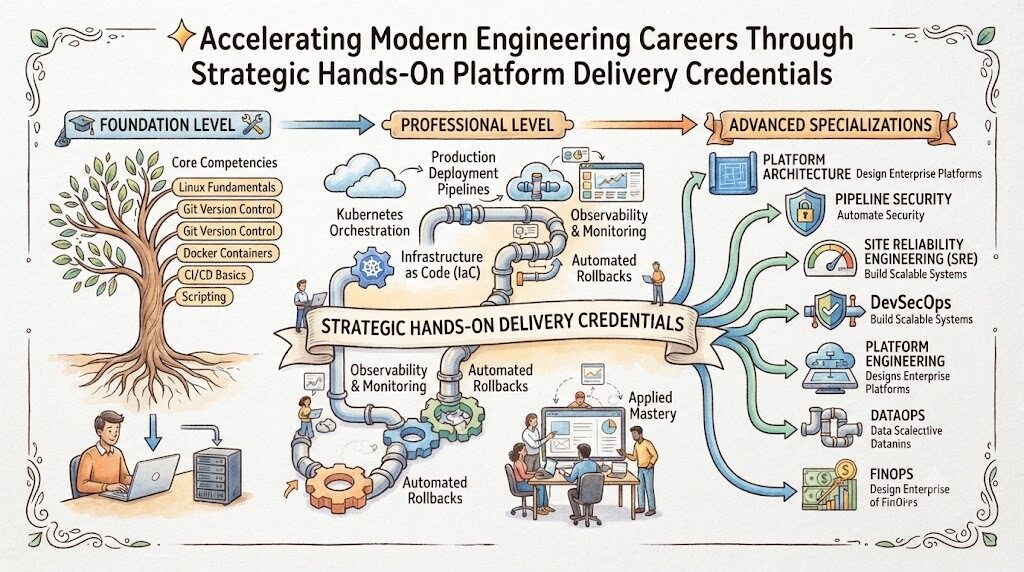
The program organizes professional advancement into three distinct tiers: Foundation, Professional, and Advanced specializations. The Foundation tier establishes baseline fluency in Linux environments, distributed source control workflows, networking essentials, and basic containerization. The Professional tier challenges engineers to construct scalable continuous integration workflows, orchestrate declarative rollouts, and enforce infrastructure automation across dynamic environments.
Advanced tracks introduce specialized branches, allowing engineers to specialize in Site Reliability Engineering, DevSecOps, Platform Engineering, or Financial Operations. Each pathway addresses distinct operational demands, such as scaling multi-tenant clusters, enforcing zero-trust security controls, or optimizing enterprise cloud expenditures. This deliberate structure empowers technical talent to match their professional growth directly with corporate engineering objectives.
Complete DevOps Certified Professional (DCP) Certification Table
| Track | Level | Who it’s for | Prerequisites | Skills Covered | Recommended Order |
| DevOps Core | Foundation | Systems Administrators, Junior Developers | Basic Linux, Command Line Basics, Git | Shell Scripting, Git Branching, Docker Fundamentals, CI/CD Concepts | 1 |
| DevOps Delivery | Professional | Software Engineers, Build Engineers | Container experience, Git proficiency | Jenkins, GitLab CI, Artifact Management, Automated Pipelines | 2 |
| Platform Operations | Advanced | Senior Engineers, Infrastructure Architects | Professional Track, Production Experience | Kubernetes Orchestration, Terraform, Ansible, GitOps Workflows | 3 |
| SRE & Resilience | Advanced | Site Reliability Engineers, Systems Engineers | Linux Internals, Scripting Skills | Prometheus, Grafana, SLO/SLI Management, Incident Response | 4 |
| DevSecOps & Governance | Advanced | Security Analysts, DevSecOps Engineers | CI/CD familiarity, Cloud Basics | SAST/DAST Tooling, Vault, Trivy, Container Hardening, Policy as Code | 5 |
| FinOps Cloud Economics | Advanced | Cloud Engineers, Engineering Managers | Cloud billing access, Basic Architecture | Cost Allocation, Rightsizing Strategies, Cloud Financial Management | 6 |
Detailed Guide for Each DevOps Certified Professional (DCP) Certification
DevOps Certified Professional (DCP) – Foundation Level
What it is
This baseline credential certifies that an engineer commands essential operating system mechanics, standard version control protocols, and basic container runtimes. It validates that a practitioner understands the software delivery lifecycle and can execute routine automation tasks without supervised instruction.
Who should take it
Associate software developers, support engineers seeking transitions into systems engineering, and legacy systems administrators adapting to modern cloud environments should begin with this level.
Skills you’ll gain
Master core Linux administration, process monitoring, file ownership, and system diagnostics.
Execute multi-branch Git strategies, resolve complex rebase conflicts, and automate commit hooks.
Package applications into optimized, lightweight container images using containerization tools.
Construct straightforward continuous integration pipelines that trigger automated unit tests on commit.
Real-world projects you should be able to do
Automate operating system patching and log rotation across server fleets using custom shell scripts.
Package a full-stack web application into production-ready container images with minimal disk footprints.
Create a simple automation pipeline that builds and verifies pull requests automatically before merges.
Preparation plan
7–14 days: Practice Linux system navigation, user administration, file permissions, and essential shell commands daily.
30 days: Build small web applications, write multi-stage container build files, and resolve merge conflicts using Git.
60 days: Combine shell scripts, containers, and pipeline runners to build an end-to-end automated testing environment.
Common mistakes
Relying on graphical user interfaces instead of mastering command-line utilities and flags.
Ignoring fundamental Linux networking concepts like subnets, routing tables, and DNS resolution.
Hardcoding configuration parameters and access keys directly into public container files and scripts.
Best next certification after this
Same-track option: DevOps Certified Professional (DCP) – Professional Level
Cross-track option: Site Reliability Engineering Foundation
Leadership option: Certified Agile Technical Lead
DevOps Certified Professional (DCP) – Professional Level
What it is
This advanced validation confirms an engineer's ability to design, implement, and maintain enterprise continuous integration and continuous deployment pipelines. It demonstrates that the candidate builds resilient deployment mechanisms, manages artifact registries, and provisions cloud infrastructure via code.
Who should take it
Mid-career infrastructure engineers, cloud automation specialists, and backend developers seeking full ownership over their team's deployment pipelines and runtime configurations.
Skills you’ll gain
Author declarative continuous delivery pipelines with complex parallel stages and quality gates.
Provision cloud infrastructure resources reproducibly using declarative infrastructure-as-code frameworks.
Integrate dynamic secret retrieval mechanisms into deployment processes safely.
Execute advanced deployment strategies, including blue-green cutovers and automated canary analyses.
Real-world projects you should be able to do
Construct an automated deployment pipeline that executes static security checks, tests code, and deploys artifacts.
Provision multi-environment cloud infrastructure using modular, version-controlled declarative code.
Execute an automated canary deployment that monitors error rates and triggers rollbacks during anomalies.
Preparation plan
7–14 days: Study syntax patterns for declarative continuous integration tools and infrastructure-as-code modules.
30 days: Build pipelines that deploy sample microservices across development, staging, and production environments.
60 days: Implement complete infrastructure automation suites featuring dynamic secret storage and automated rollbacks.
Common mistakes
Storing continuous integration tokens and deployment credentials within public code repositories.
Writing procedural scripts instead of building idempotent, declarative infrastructure definitions.
Omitting automated rollback mechanisms, leaving production environments vulnerable during bad deployments.
Best next certification after this
Same-track option: DevOps Certified Professional (DCP) – Advanced Platform Level
Cross-track option: DevSecOps Certified Practitioner
Leadership option: Enterprise Cloud Delivery Lead
DevOps Certified Professional (DCP) – Advanced Platform Level
What it is
This elite credential validates mastery over large-scale distributed systems orchestration, GitOps automation frameworks, and internal developer platform architecture. It confirms that an engineer can build self-healing, multi-tenant container platforms that support dozens of software engineering teams simultaneously.
Who should take it
Principal infrastructure engineers, lead DevOps architects, and enterprise systems designers who design high-concurrency cloud-native platforms.
Skills you’ll gain
Architect scalable container clusters, manage custom networking interfaces, and tune scheduling engines.
Implement GitOps controllers that continuously synchronize runtime clusters with version-controlled code.
Deploy service mesh architectures to govern traffic routing, observe microservices, and enforce mutual TLS.
Develop custom platform automation controllers to extend standard container platform capabilities.
Real-world projects you should be able to do
Deploy a secure, multi-tenant Kubernetes platform that enforces compute quotas and network segmentation.
Implement continuous GitOps reconciliation to detect and automatically correct unauthorized cluster drift.
Route production microservice traffic dynamically using service mesh rules to execute live A/B experiments.
Preparation plan
7–14 days: Master internal container networking concepts, ingress architectures, and persistent storage drivers.
30 days: Build local multi-node clusters that leverage GitOps tools to deploy microservices automatically.
60 days: Construct production-grade environments with integrated service meshes, observability stacks, and autoscaling policies.
Common mistakes
Omitting resource requests and limits across workloads, causing cluster crashes during traffic spikes.
Creating overly complex abstractions that confuse application developers instead of simplifying their workflows.
Neglecting cluster security benchmarks and running workloads with unrestricted administrative privileges.
Best next certification after this
Same-track option: Cloud Solutions Master Architect
Cross-track option: Site Reliability Engineering Operations Master
Leadership option: Director of Platform Engineering
Choose Your Learning Path
DevOps Path
Engineers choosing this foundational path master the art of accelerating software delivery without sacrificing system stability. Candidates learn to eliminate deployment roadblocks by automating continuous integration workflows, provisioning declarative cloud infrastructure, and orchestrating zero-downtime releases. Practitioners create clean, automated delivery pipelines that empower product teams to ship features continuously.
DevSecOps Path
This path teaches security-minded engineers to embed security controls into every phase of the software delivery lifecycle. Professionals master automated container vulnerability scanning, integrate static and dynamic code analyzers into continuous integration systems, and enforce policy-as-code frameworks. Graduates safeguard production environments by stopping security flaws long before applications reach production.
SRE Path
Site Reliability Engineering focuses on applying rigorous software engineering principles directly to systems operations challenges. Practitioners master actionable telemetry, calculate error budgets, set achievable service level objectives, and lead blameless incident post-mortems. This track molds specialists who keep mission-critical platforms highly available, scalable, and resilient against unexpected operational shocks.
AIOps Path
This emerging discipline equips technical professionals to apply advanced machine learning models directly to systems operations data. Engineers learn to parse high-volume log streams, suppress alert noise, spot operational anomalies early, and trigger automated remediation scripts. Practitioners who master this discipline dramatically reduce the time it takes to diagnose and resolve production incidents.
MLOps Path
Machine learning specialists on this path build reliable platforms that move artificial intelligence prototypes smoothly into production environments. Candidates master automated model retraining pipelines, track data and model lineage, manage model registries, and observe inference endpoints for concept drift. This route turns data science projects into stable, scalable software delivery components.
DataOps Path
Data engineers selecting this path adapt agile software methodologies to complex data analytics environments. Practitioners learn to build automated data validation steps, establish continuous data integration, and schedule complex transformations across data warehouses. This specialized training empowers engineers to deliver high-quality, verified data products to enterprise stakeholders quickly and reliably.
FinOps Path
The FinOps specialization unites technical execution with financial accountability to optimize enterprise cloud budgets. Professionals master cloud cost tagging taxonomies, evaluate resource utilization metrics, rightsize overprovisioned infrastructure, and manage committed cloud discount models. This track produces engineers who maximize business value without limiting platform performance or slowing release cycles.
Role to Recommended DevOps Certified Professional (DCP) Certifications
| Role | Recommended Certification Level | Primary Focus Area | Key Career Outcome |
| DevOps Engineer | DCP – Professional Level | Automated Delivery Pipelines, CI/CD | Accelerated deployment velocity and release reliability |
| SRE | DCP – SRE & Resilience | Incident Management, Telemetry, SLOs | Minimized downtime and automated operational resilience |
| Platform Engineer | DCP – Advanced Platform Level | Kubernetes, GitOps, Internal Platforms | Streamlined developer workflows and cluster scaling |
| Cloud Engineer | DCP – Professional Level | Cloud Automation, Infrastructure as Code | Consistent, declarative cloud infrastructure provisioning |
| Security Engineer | DCP – DevSecOps & Governance | Shift-Left Security, Secret Management | Automated container scanning and compliance controls |
| Data Engineer | DCP – DataOps Specialization | Data Pipelines, Pipeline Automation | Dependable data pipelines and automated quality checks |
| FinOps Practitioner | DCP – FinOps Cloud Economics | Cloud Billing, Rightsizing, Budgeting | Controlled cloud spend and optimized infrastructure ROI |
| Engineering Manager | DCP – Foundation & FinOps | Delivery Metrics, Platform Governance | Data-informed technical leadership and resource management |
Next Certifications to Take After DevOps Certified Professional (DCP)
Same Track Progression
Seasoned engineers should deepen their technical dominance by pursuing specialized platform engineering and distributed systems credentials. Advancing within this track requires designing custom orchestration controllers, building self-healing systems, and running multi-region cloud networks. This technical depth positions practitioners for principal platform engineer, enterprise cloud architect, and distinguished technologist roles.
Cross-Track Expansion
Broadening your technical range into Site Reliability Engineering, cybersecurity governance, or cloud economics creates a versatile, highly competitive career profile. Integrating automated security scanning into continuous delivery pipelines or managing cloud spending while preserving system availability marks you as an indispensable systems thinker. Modern enterprises depend heavily on versatile technical leaders who bridge operations, security, and finance effortlessly.
Leadership & Management Track
Engineers transitioning into leadership positions should shift their focus from day-to-day command-line operations toward engineering delivery metrics and talent development. Mastering software delivery metrics, modern development practices, and cross-functional team management prepares you to lead large engineering organizations. This progression empowers leaders to translate technical infrastructure investments directly into business outcomes.
Training & Certification Support Providers for DevOps Certified Professional (DCP)
DevOpsSchool
DevOpsSchool delivers comprehensive technical education programs that prepare engineering professionals to build and manage modern cloud-native systems. Through structured, mentor-led courses, the organization helps students master continuous delivery tools, container orchestration, and automated infrastructure frameworks. Students gain access to production-like environments, comprehensive technical libraries, and hands-on exercises that mirror real-world platform challenges. The platform focuses on equipping candidates with practical troubleshooting skills to solve enterprise infrastructure problems independently.
Cotocus
Cotocus offers high-impact corporate training and infrastructure consulting services to support enterprise digital transformations. Their instructors focus on real-world operational challenges, teaching students how to automate deployments, configure container clusters, and manage complex release schedules. The curriculum emphasizes active systems debugging, idempotent infrastructure provisioning, and production reliability. By solving realistic failure scenarios in modern cloud environments, candidates build the practical skills needed to support critical corporate infrastructure.
Scmgalaxy
Scmgalaxy provides an expansive open-source knowledge repository, community forums, and focused training modules for software release specialists. The platform features practical guides covering version control strategies, automated build systems, and continuous delivery pipelines. Software developers and operations engineers use this resource hub to learn configuration management and build automation. Its practical tutorials help teams improve delivery reliability across enterprise development teams.
BestDevOps
BestDevOps publishes insightful technical analyses, platform evaluations, and career roadmaps for cloud infrastructure engineers. The site cuts through marketing hype to deliver objective assessments of continuous deployment engines, cluster managers, and observability frameworks. Engineers use its guides and best-practice blueprints to design maintainable, automated systems. By highlighting modern engineering patterns, the platform helps professionals make informed architecture choices.
devsecopsschool.com
devsecopsschool.com delivers focused coursework designed to embed security testing directly into continuous software delivery pipelines. The curriculum teaches engineers how to manage container image vulnerabilities, configure secrets management tools, write policy-as-code guardrails, and execute automated code scans. Students learn how to catch security flaws early in development without slowing release schedules. This training gives candidates the skills needed to lead DevSecOps initiatives across enterprise organizations.
sreschool.com
sreschool.com trains operations engineers and platform specialists in the principles of Site Reliability Engineering and systems availability. Its coursework explores telemetry architectures, distributed tracing, incident response protocols, and service level objective management. Students learn how to minimize production downtime, build self-healing systems, and conduct constructive, blameless incident reviews. The platform prepares candidates to run highly available, scalable services under demanding enterprise conditions.
aiopsschool.com
aiopsschool.com prepares engineers to apply modern machine learning techniques directly to infrastructure operations challenges. Students learn how to process large volumes of operational telemetry, filter out alert noise, identify real-time performance anomalies, and trigger automated remediations. The curriculum helps practitioners transition from manual operations to proactive, automated platforms. Engineers develop the specialized skills needed to manage complex distributed platforms efficiently.
dataopsschool.com
dataopsschool.com applies agile software engineering principles directly to distributed data systems and analytical pipelines. The platform teaches data practitioners how to automate data quality validation, configure continuous delivery for data warehouses, and monitor data health. Students learn to eliminate data delivery bottlenecks and build dependable, test-driven pipelines. This training enables engineers to deliver consistent, accurate analytical data to enterprise decision-makers.
finopsschool.com
finopsschool.com educates cloud professionals and technical managers on cloud financial governance and infrastructure cost optimization. Its courses guide students through resource utilization analytics, workload rightsizing, cost-allocation tagging, and committed cloud discount management. Students master the frameworks needed to balance platform performance, release speed, and cloud spending. This curriculum bridges technical execution and corporate finance, helping engineering teams maximize their cloud investments.
Frequently Asked Questions (General)
1. How difficult is it to earn modern DevOps certifications?
Practical examinations that evaluate hands-on troubleshooting present a rigorous challenge because they test actual system configurations rather than memorized theory. Candidates must understand command-line tools, pipeline syntax, and Linux operating systems thoroughly to build, diagnose, and repair active systems under timed conditions.
2. How much time should candidates allocate for certification preparation?
Working professionals typically spend four to eight weeks preparing, dedicating eight to ten hours weekly to hands-on laboratory exercises. Candidates without prior Linux systems administration or scripting experience often require twelve weeks to master essential networking, command-line, and automation fundamentals.
3. What foundational prerequisites should an engineer possess before enrolling?
Practitioners should master basic Linux system navigation, version control operations using Git, essential networking concepts like DNS and HTTP, and straightforward shell scripting. While advanced software engineering skills are not strictly mandatory, knowing how to write basic code significantly accelerates your progress.
4. Do modern platform credentials deliver tangible career returns?
Certified practitioners consistently earn higher compensation, secure high-impact platform engineering roles, and gain greater architectural influence within modern engineering organizations. The primary value stems from acquiring structured, battle-tested troubleshooting capabilities that immediately improve everyday production uptime.
5. Which sequence of certifications provides the most logical career progression?
Engineers should start with foundational Linux, networking, and Git version control competencies before mastering continuous integration and automated deployment pipelines. From there, practitioners should advance to container orchestration platforms like Kubernetes, followed by specialized tracks in DevSecOps, SRE, or FinOps.
6. How often do enterprise platform certifications require renewal?
Industry-standard programs typically require renewal or continuing professional education credits every two to three years. Because cloud tools, container technologies, and release patterns evolve rapidly, recertification ensures that certified engineers remain current with modern production standards.
7. Can full-stack software developers transition smoothly into platform engineering?
Software developers make exceptional platform engineers because they bring disciplined programming, unit testing, and software design principles directly to infrastructure automation challenges. Developers simply need to master container orchestration, operating system internals, and cloud networking architectures to transition successfully.
8. Should professionals pursue vendor-neutral credentials or cloud-specific certifications?
Vendor-neutral certifications teach transferable, underlying architectural patterns like declarative configuration, containerization, and GitOps workflows without tying your career to a single proprietary vendor. Combining vendor-neutral frameworks with specific public cloud credentials provides the most balanced, versatile career foundation.
9. How much time should an aspiring platform engineer dedicate to learning Kubernetes?
Kubernetes serves as the standard orchestration engine across modern enterprise infrastructure worldwide, making it an essential platform component. Engineers must invest considerable time mastering pod scheduling, custom resources, network policies, ingress controllers, and storage primitives to succeed in platform engineering.
10. Does modern platform engineering require active software programming skills?
Engineers do not need to write user-facing web applications, but they must write clean, maintainable automation code using languages like Python, Go, or advanced Bash. Modern infrastructure as code and telemetry APIs require programmatic interaction to run reliable delivery pipelines.
11. How do the daily responsibilities of SREs differ from DevOps engineers?
DevOps engineers build and maintain the continuous delivery pipelines that help software developers package and deploy applications smoothly. Site Reliability Engineers use software engineering principles to preserve platform availability, calculate service level objectives, monitor infrastructure health, and resolve live outages.
12. How do technical platform credentials assist engineering managers?
Earning technical credentials helps engineering managers understand modern cloud platforms, delivery metrics, and architectural constraints. This direct technical grounding enables leaders to estimate team velocity accurately, remove operational blockers, and make smart capital investments in infrastructure.
FAQs on DevOps Certified Professional (DCP)
1. What operational distinctions set the DevOps Certified Professional (DCP) apart from standard industry tests?
The DevOps Certified Professional (DCP) evaluates practical system implementation and dynamic troubleshooting skills in live lab environments, eliminating multiple-choice memorization entirely. Candidates must configure working continuous delivery pipelines, provision infrastructure via code, and diagnose container platform errors under realistic time constraints.
This performance-based testing model ensures that certified engineers possess genuine operational competence, making the credential a reliable hiring signal for enterprise technology organizations.
2. Can an infrastructure administrator without software engineering experience pass the DevOps Certified Professional (DCP)?
Infrastructure administrators who understand basic scripting and operational logic can pass the exam through targeted preparation. While candidates do not write application code, they must read, modify, and author declarative configuration files, infrastructure scripts, and pipeline definitions.
Administrators should invest time in learning basic Python or Bash logic to complete automation tasks quickly and pass the assessment.
3. How does the examination process evaluate an engineer's technical ability?
Candidates complete hands-on practical challenges within dynamic sandbox environments that mirror production enterprise platforms. Evaluators require candidates to repair failing continuous deployment pipelines, secure open container runtimes, configure automated health checks, and rectify infrastructure-as-code drifts.
The evaluation framework automatically grades candidate success based on the availability, resilience, and operational correctness of the final environment.
4. How does holding the DevOps Certified Professional (DCP) credential accelerate career growth?
This certification signals to hiring directors and engineering managers that you possess validated experience running modern cloud delivery systems. Credential holders stand out for Senior DevOps, Cloud Architect, and Site Reliability Engineering roles across global enterprises and scaling startups.
Certified engineers onboard faster, reduce deployment errors, and build stable automation, accelerating their path toward technical leadership positions.
5. What core toolchains and infrastructure stacks appear across the certification syllabus?
Candidates work directly with enterprise-grade open-source tools and infrastructure platforms, including Linux environments, Git version control, Docker containers, and Jenkins or GitLab pipelines. The curriculum also covers Terraform infrastructure as code, Kubernetes cluster orchestration, and Prometheus telemetry systems.
This broad exposure ensures that practitioners can apply their skills across private data centers, hybrid setups, and major public cloud providers.
6. How frequently do instructors and architects refresh the certification syllabus?
Senior systems architects update the certification syllabus regularly to incorporate modern cloud-native standards, tooling versions, and security practices. The program continuously phases out outdated scripts and legacy orchestration tools in favor of declarative GitOps workflows and automated compliance frameworks.
This dynamic review process ensures that certified practitioners master the modern techniques actively used by top-tier engineering organizations.
7. What local hardware and computing resources do candidates require to prepare?
Candidates need a modern personal laptop equipped with at least eight gigabytes of memory, a reliable internet connection, and free virtualization software. Students can practice building complete delivery platforms locally using lightweight container distributions like K3s, Docker Desktop, or Minikube.
Learners can also use free-tier public cloud accounts to practice provisioning remote infrastructure without spending significant money on lab setups.
8. How does the curriculum address vulnerability management and pipeline security?
The certification curriculum integrates DevSecOps principles into every continuous delivery stage rather than treating security as an afterthought. Candidates learn to configure automated container image vulnerability scanners, implement secrets management engines, and execute static code analyses.
This holistic training ensures that certified professionals build automated delivery pipelines that comply with modern enterprise security standards.
Final Thoughts: Is DevOps Certified Professional (DCP) Worth It?
Certificates on a wall do not build resilient systems or resolve live production outages. What accelerates an engineering career is the discipline developed while diagnosing complex systems, automating painful manual tasks, and designing architectures that withstand production traffic. Real cloud platforms present unpredictable network drops, hard-to-find dependency conflicts, and resource bottlenecks that theoretical tutorials fail to capture.
The DevOps Certified Professional (DCP) delivers genuine value when approached as a structured, hands-on path to master modern platform engineering. Committing to this training builds muscle memory in declarative automation, pipeline design, and infrastructure troubleshooting that will benefit you for years to come. Use this rigorous certification as an opportunity to build dependable, scalable platforms that power modern enterprise software.