Foundational Military Strategy Principles Modern Defense Studies And Multidomain Operations Architecture
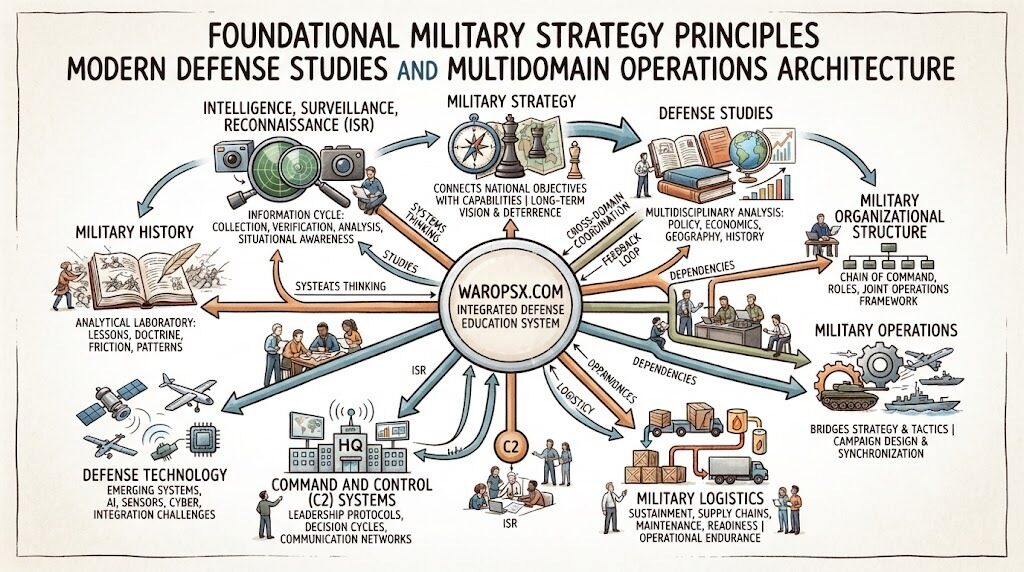
What Is WarOpsX?
WarOpsX is an educational knowledge platform designed to provide clear, systematic analysis of strategic studies, defense management, institutional structures, and military operational systems. Its primary objective is to deconstruct complex security concepts for students, academic researchers, defense enthusiasts, and policy professionals seeking conceptual depth without tactical combat instructions. By examining defense as a cohesive ecosystem, the platform bridges the gap between high-level political objectives and functional organizational realities across domains like logistics, operational art, and emerging defense technology. Readers gain access to structured learning pathways that emphasize analytical thinking, institutional mechanics, and strategic foresight, enabling both beginners and advanced researchers to explore modern security architectures from a purely academic and professional perspective.
What Does WarOpsX Cover?
The curriculum across WarOpsX encompasses the full breadth of modern security studies, emphasizing institutional readiness, operational execution, and long-term capability planning. Core subject areas include Military Strategy, Defense Studies, Military Operations, Military Logistics, Command and Control Systems, Defense Technology, Military History, Military Organizational Structure, Multidomain Operations, and Intelligence, Surveillance and Reconnaissance. Rather than examining these fields in isolation, the platform highlights the functional linkages connecting strategic policy to ground-level administrative support, technical infrastructure, and joint decision-making networks. Learners can navigate each subject systematically to build an expansive, multidisciplinary understanding of how contemporary defense institutions organize, equip, sustain, and govern their forces in competitive global environments.
Military Strategy
Military strategy serves as the vital bridge connecting national political objectives with the generation, posture, and employment of defense capabilities over extended time horizons. Unlike localized tactics focused on winning individual engagements, strategy governs long-term resource allocation, comprehensive risk assessment, deterrence posture, structural preparedness, and high-level decision-making under uncertainty. For example, while a tactical unit concentrates on securing an individual intersection or ridge, a strategic framework dictates whether an entire theater receives industrial prioritization, diplomatic backing, or sustained budgetary resources. By mastering the core principles of strategic doctrine, defense students learn to evaluate how state leadership balances competing international interests, allocates finite national wealth, and establishes credible deterrence against potential adversaries.
Defense Studies
Defense studies operates as a broad multidisciplinary field examining the preservation of national security through diverse academic, economic, and institutional perspectives. This field links international relations, public policy, military history, industrial economics, geographic constraints, technology forecasting, and organizational behavior into a unified discipline. Students of defense studies examine security far beyond the limits of military equipment inventories, analyzing instead how legislative budgets, diplomatic alliances, industrial supply bases, and societal cohesion shape a nation's defense posture. Understanding these interdisciplinary connections equips researchers to evaluate the durability of security policies, assess sovereign vulnerabilities, and understand why institutional design matters just as much as weapon procurement.
Military Operations
Military operations occupy the critical intermediate level of military art, translating grand strategic goals into coordinated campaigns and major joint actions. This operational level focuses on synchronization, campaign design, theater-wide resource distribution, logistical sequencing, institutional readiness, and collaborative decision-making across disparate service branches. High-level operational art ensures that individual activities do not occur in a vacuum; instead, every movement, base establishment, and defensive posture directly advances overarching national policies while conserving vital personnel and material resources. Studying operational concepts enables defense enthusiasts to appreciate the organizational discipline, complex timelines, and multi-echelon coordination required to mobilize and sustain massive institutional forces during prolonged crises.
Military Logistics
Logistics forms the foundation of all sustained operational readiness, dictating the practical limits of what any security organization can achieve. A military organization cannot function without resilient supply chains, heavy transportation assets, scheduled depot maintenance, bulk fuel distribution, medical evacuation infrastructure, secure warehousing, and reliable spare-parts management. Consider a scenario where a modern mechanized formation deploys advanced armored assets into an operational theater: if bulk fuel supplies run dry or unpaved transportation corridors wash out, those multimillion-dollar platforms turn into immobile, vulnerable assets regardless of their firepower. Analyzing supply network design demonstrates why master strategists historically prioritize logistical sustainment and distribution pipelines over raw combat inventories.
Command and Control Systems
Command and control systems, commonly termed C2, establish the structural authority, communications infrastructure, and organizational protocols through which leaders direct dispersed forces. Effective C2 systems guide operational workflows through a continuous cycle: incoming information is processed through rigorous analysis, converted into leadership decisions, communicated as clear operational direction, executed by subordinate formations, and evaluated via real-time feedback loops. Technology like secure satellite relays and digital battle-management software enhances this operational rhythm, yet resilient organizational design remains paramount to prevent information overload at headquarters level. A functional C2 framework ensures clear delegation, distinct accountability, and rapid decision-making across fluid operational theaters.
Defense Technology
Emerging defense technology continuously alters the speed, range, and lethality of modern security environments, shaping how institutions prepare for competitive operations. Key modernization areas include artificial intelligence, autonomous robotic systems, distributed sensor networks, quantum-resistant communications, digital twin simulations, offensive and defensive cyber capabilities, big-data analytics, and automated decision-support interfaces. However, implementing advanced hardware alone does not resolve core institutional challenges; successful adoption requires thorough personnel instruction, ethical governance frameworks, multi-branch interoperability, rigorous cybersecurity hardening, continuous depot maintenance, human-in-the-loop oversight, and high data integrity. Modern defense analysts must evaluate whether emerging tools integrate smoothly into existing organizational workflows or introduce administrative friction.
Military History
Military history offers learners an empirical laboratory for evaluating strategic decisions, organizational evolutions, and technological transitions across various operational environments. Studying past campaigns reveals how institutional adaptation, geographic obstacles, logistical bottlenecks, intelligence shortfalls, and resource scarcity dictated historical outcomes under severe friction. Rather than simply memorizing battle dates, modern defense students analyze historical case studies to understand why specific command structures succeeded while rigid, over-centralized organizations collapsed under stress. Examining institutional successes and catastrophic planning failures from the past provides contemporary researchers with critical analytical frameworks to assess today's emerging operational dilemmas and doctrine.
Military Organizational Structure
A clearly defined military organizational structure establishes the legal hierarchy, operational relationships, functional divisions, and administrative accountability necessary to manage complex defense enterprises. Modern structures span national command authorities, joint headquarters, unified combatant commands, distinct service branches, administrative corps, divisions, brigades, and specialized task forces. This organizational clarity ensures that communication channels remain open, resource allocations flow smoothly, responsibilities do not overlap, and operational decisions are executed with legal oversight. Understanding how military bureaucracies balance peacetime administrative duties with crisis operational demands helps researchers appreciate why well-structured command relationships are vital for organizational cohesion and operational success.
Multidomain Operations
Multidomain operations represent the operational evolution beyond traditional service-specific coordination, synchronizing institutional actions simultaneously across land, maritime, air, space, cyber, and information domains. This operational approach recognizes that actions executed in one domain inherently create vulnerabilities or strategic advantages within adjacent operating environments. For example, securing air superiority increasingly relies on terrestrial mobile air defenses, space-based orbital tracking sensors, robust cyber protection for communications networks, and disciplined management of the electromagnetic spectrum. Exploring multidomain operational concepts teaches defense learners how cross-domain dependencies, shared digital infrastructure, and joint logistical pipelines generate operational resilience against sophisticated adversaries across non-contiguous operating areas.
Intelligence, Surveillance and Reconnaissance
Intelligence, Surveillance and Reconnaissance, universally known as ISR, encompasses the synchronized collection, processing, and dissemination of timely, accurate information to support strategic decision-makers. The discipline functions through a continuous intelligence cycle: systematic data collection via orbital sensors, uncrewed systems, and human observation leads to data processing, analytical fusion, multi-source assessment, and actionable decision support. Reliable ISR establishes theater situational awareness, illuminates adversary intentions, mitigates uncertainty, and guides defensive resource distribution while guarding against cognitive bias and deception. By studying ISR methodologies conceptually, defense researchers gain insight into how modern analytical workflows turn massive streams of unstructured surveillance data into coherent strategic awareness.
How Military Strategy, Operations, Logistics, and Technology Connect
Understanding modern national security requires systems thinking, as defense disciplines do not operate as isolated, independent silos. Within this unified ecosystem, strategy first outlines sovereign political objectives and deterrence priorities, which operational campaign planners translate into executable joint maneuvers and functional theater tasks. Institutional organizational structures assign clear authority, responsibilities, and accountability to various units, while logistical networks provide the fuel, parts, medical supplies, and transportation infrastructure needed to sustain these distributed formations. Concurrently, defense technology delivers modern communications, mobility platforms, and sensor capabilities, feeding raw surveillance data into command-and-control cycles for analytical processing and high-level decision-making. Leadership serves as the vital human component binding this entire mechanism together, ensuring that strategic goals drive technological integration, organizational structure aligns with operational missions, and logistical capabilities govern the operational pace. When any single link within this interconnected chain fails—whether due to neglected supply lines, incompatible communications hardware, or ambiguous command authority—the entire strategic apparatus breaks down, proving that true defense preparedness relies on systemic harmony rather than individual technological advantages.
| Area | What It Covers | Why It Matters |
| Military Strategy | Sovereign objectives, resource allocation, deterrence, and high-level defense planning. | Connects national security goals with practical military capabilities. |
| Defense Studies | Interdisciplinary policy, strategic economics, public affairs, and security studies. | Provides broad socio-political and economic context to defense affairs. |
| Military Operations | Campaign design, theater coordination, readiness, and joint synchronization. | Bridges national strategy with functional tactical execution. |
| Military Logistics | Supply-chain security, maintenance, transportation, fuel, and medical services. | Sustains operational readiness and sets the limits of endurance. |
| Command and Control | Authority frameworks, communications systems, and operational workflows. | Facilitates unified decision-making and cross-echelon coordination. |
| Defense Technology | Artificial intelligence, autonomous platforms, cyber capabilities, and sensors. | Modernizes organizational capabilities, communication, and situational analysis. |
| Military History | Historical campaigns, doctrine evolution, and institutional adaptation. | Supplies empirical case studies to analyze strategic patterns. |
| Organizational Structure | Military hierarchy, command relationships, and structural accountability. | Ensures clear lines of authority, responsibility, and efficient communication. |
| Multidomain Operations | Coordination across land, sea, air, orbital space, cyber, and information domains. | Mitigates cross-domain operational dependencies and joint vulnerabilities. |
| ISR Systems | Integrated information collection, data fusion, and intelligence assessment. | Generates situational awareness to inform timely, responsible decisions. |
Real-Life Scenarios
Theater-Wide Fuel and Maintenance Shortages Imposing Operational Pauses: A mechanized armored division rapidly advances along an interior corridor but outruns its heavy fuel-tanker convoys and field maintenance battalions, leaving cutting-edge combat platforms stranded along main supply routes and halting operations until support elements arrive.
Incompatible Inter-Service Communication Systems Hindering Joint Coordination: During a complex disaster-relief and security-stabilization mission, naval communications protocols fail to integrate with ground-based radio networks, forcing commanders to rely on slow, manual coordination that delays medical evacuations and regional supply drops.
Degraded Satellite Networks Paralyzing Centralized Decision-Making: An unexpected orbital communications disruption blinds high-altitude sensor relays and remote command centers, leaving headquarters cut off from field formations and forcing lower-level commanders to rely on mission-type orders to maintain local security.
Unscreened Surveillance Floods Overwhelming Operational Headquarters: A newly deployed automated aerial sensor network transmits thousands of hours of raw, unindexed reconnaissance footage to an intelligence cell, overwhelming analyst processing capacity and delaying critical warnings of adversary movements.
How to Use WarOpsX for Structured Learning
Step 1: Begin with fundamental Defense Studies guides to understand how national policy, international relations, economics, and geography shape security environments before diving into operational technicalities.
Step 2: Explore the Military Strategy curriculum to learn how states establish deterrence policies, assess geopolitical risks, and allocate resources between peacetime readiness and crisis modernization.
Step 3: Examine Military Organizational Structure resources to gain clarity on military hierarchy, administrative chains of command, combatant commands, and functional branch responsibilities.
Step 4: Study Military Logistics and operational sustainment frameworks to appreciate how transportation, depot maintenance, spare parts, and supply chains dictate operational feasibility.
Step 5: Investigate Command and Control Systems alongside Intelligence, Surveillance and Reconnaissance models to discover how raw intelligence data moves through processing cycles into operational decisions.
Step 6: Review Multidomain Operations modules to understand how modern defense planners integrate activities across land, sea, air, space, cyber, and the electromagnetic spectrum.
Step 7: Synthesize your acquired operational knowledge through historical case studies and emerging defense technology research, assessing how past lessons apply to modern AI-driven environments.
Who Can Benefit From WarOpsX?
Defense Studies and International Relations Students: Gain structured, academic-grade context that connects classroom political theories with modern defense resource allocation, force posture, and joint security structures.
Security Researchers and Policy Analysts: Access high-level organizational breakdowns and operational frameworks to evaluate regional balances of power, industrial supply vulnerabilities, and modernization budgets.
Military History Enthusiasts: Move beyond surface-level narratives of battles to explore the logistical systems, command relationships, and structural adaptations that decided major campaigns.
Defense Technology Engineers and Tech Professionals: Understand how emerging software, autonomous platforms, and sensor systems integrate into military hierarchies, standard command structures, and multi-echelon networks.
Public Policy Learners and Civil Servants: Build a foundational literacy in defense architecture, command accountability, and multi-domain requirements to evaluate defense procurement, legislation, and national security investments.
Independent Learners and Strategic Enthusiasts: Discover an accessible, step-by-step pathway to master complex defense systems without needing prior institutional or military service experience.
Why Understanding Defense as a System Matters
Analyzing national security through systems thinking prevents learners from reducing defense capabilities to weapon inventories, equipment specifications, or headcounts. Real defense capability emerges from the dynamic interaction among human leadership, strategic foresight, industrial logistics, transparent command authority, communications infrastructure, and organizational adaptability under stress. A military organization equipped with state-of-the-art platforms will rapidly fail if its administrative structure prevents timely communication, its logistics network runs out of spare parts, or its strategy misinterprets geopolitical conditions. By approaching defense studies as an integrated, multi-variable discipline, researchers and students can accurately assess institutional readiness, anticipate strategic failures, and evaluate defense policy through a mature, realistic lens.
Common Mistakes to Avoid
Equating Tactical Combat Success with Strategic Victory: Assuming that winning localized tactical engagements automatically guarantees the achievement of broad national security goals, ignoring political, diplomatic, and economic outcomes.
Focusing Exclusively on Hardware While Ignoring Logistics: Overemphasizing advanced tanks, aircraft, or ships while disregarding the supply chains, fuel reserves, maintenance facilities, and transport assets required to run them.
Treating Technology as a Panacea for Poor Organization: Expecting artificial intelligence or advanced digital platforms to fix deep-seated institutional dysfunction, unclear command hierarchies, or inadequate personnel education.
Confusing the Tactical Level of War with the Operational Level: Failing to distinguish between localized combat techniques and theater-level campaign design, joint asset synchronization, and sustained resource management.
Memorizing Military History Dates Instead of Analyzing Systems: Focusing on battle timelines and combat personalities rather than examining the underlying logistical limitations, institutional adaptations, and command failures that shaped outcomes.
Overlooking Cross-Domain Vulnerabilities in Joint Operations: Analyzing land or maritime operations without accounting for dependencies on orbital satellite communication, airspace control, cyber defense, and electromagnetic spectrum access.
Viewing Command and Control as Merely Radio Equipment: Treating C2 strictly as communications hardware rather than an integrated framework of organizational authority, information filtering, leadership, and operational feedback.
Assuming More Intelligence Data Automatically Yields Better Decisions: Believing that high-volume surveillance collection guarantees situational awareness, ignoring the processing bottlenecks, analytical biases, and verification challenges that cause decision fatigue.
1. What makes military strategy distinct from military tactics?
Military strategy sets long-term national security objectives, coordinates resource allocation, and aligns diplomatic, economic, and defense power to achieve overarching political goals. In contrast, tactics focuses on the localized maneuvers and techniques used by units to complete specific, immediate tasks. Understanding this distinction prevents learners from mistaking temporary combat achievements for sustainable strategic success.
2. Why is logistics considered the backbone of operational readiness?
Logistics directly determines the operational endurance, mobility, and functional reach of any security organization. Without steady deliveries of fuel, replacement components, medical supplies, ammunition, and scheduled mechanical maintenance, modern high-tech platforms quickly become unusable assets. Even the most carefully crafted operational plan fails if the supply network cannot sustain forces deployed across distant theaters.
3. What does multidomain operations mean in simple terms?
Multidomain operations describes the synchronized employment of capabilities across land, maritime, air, space, and cyberspace domains, as well as the information environment. Rather than conducting separate, isolated service campaigns, modern forces coordinate operations so that success in one domain—such as cyberspace or orbital tracking—creates decisive operational openings and protection for forces operating in others.
4. How do command and control systems influence operational pace?
Command and control systems establish the communications infrastructure, legal authority, and decision-making workflows through which commanders evaluate situational data and issue directives. Efficient C2 architectures accelerate this operational loop by filtering raw data, clarifying responsibilities, and decentralizing local execution. This streamlined flow allows organizations to respond quickly to developing security crises without succumbing to administrative bottlenecks.
5. Why should defense studies students examine military history?
Military history serves as an empirical database detailing how real defense organizations adapted to friction, resource scarcity, and unexpected crises throughout past eras. Analyzing historical case studies helps students observe the recurring systemic consequences of poor logistics, rigid command hierarchies, and misaligned strategic assumptions, providing valuable context for evaluating modern security policies and emerging technological dilemmas.
6. What role does artificial intelligence play in modern defense systems?
Artificial intelligence enhances data processing speeds, automates target recognition, optimizes supply chains, and provides automated decision support to reduce cognitive overload in operational headquarters. However, AI remains an enabling tool rather than an independent solution; it still requires rigorous data management, human oversight, ongoing cybersecurity, and resilient organizational integration to be effective in high-stakes environments.
7. How does organizational structure affect accountability in defense institutions?
A clearly defined military hierarchy delineates specific command authorities, legal jurisdictions, operational responsibilities, and reporting obligations across every echelon. This structural clarity prevents jurisdictional confusion during fast-moving crises, guarantees civilian constitutional oversight, and ensures that commanders remain accountable for operational performance, resource management, and administrative adherence to applicable international legal frameworks.
8. What is the primary function of the operational level of war?
The operational level of war links high-level strategic objectives with ground-level tactical tasks by designing, orchestrating, and sustaining theater-wide campaigns. Operational art sequences major movements, allocates theater resources, coordinates joint service capabilities, and establishes operational pauses. This comprehensive coordination ensures individual tactical engagements directly advance overarching national strategic goals.
9. How does the ISR cycle transform raw data into actionable decisions?
The ISR cycle systematically routes collected surveillance data through rigorous processing, multi-source fusion, and contextual analysis to produce refined strategic intelligence. By filtering out deceptive signals, corroborating sensor data, and evaluating uncertainties, the process transforms confusing information streams into clear, objective assessments. These refined insights help leadership make measured, well-timed decisions during unfolding crises.
10. Why is systems thinking necessary for analyzing national security?
Systems thinking recognizes that national defense relies on the complex interaction of strategy, logistics, command relationships, technological infrastructure, and human leadership rather than isolated platforms. Evaluating a defense institution through this holistic lens helps researchers identify critical hidden vulnerabilities, forecast operational friction, and recognize why technological superiority cannot overcome deep organizational or logistical shortfalls.
11. How does peacetime resource allocation influence wartime capability?
Peacetime resource allocation dictates the long-term industrial capacity, personnel education, technological research, and infrastructure maintenance that define a nation's mobilization potential. Decisions made during peacetime budget cycles determine whether a state possesses the sustained industrial base, spare parts reserves, and logistical durability required to respond effectively when sudden geopolitical crises emerge.
12. In what ways do cyber operations impact traditional physical operating domains?
Cyber operations can disrupt critical civilian infrastructure, disable tactical communications networks, corrupt sensor feeds, and compromise industrial supply chains far behind traditional front lines without firing a shot. By degrading the digital networks that support command and control, logistics tracking, and air defense coordination, cyber tools directly shape operational options across the physical land, sea, and air domains.
Conclusion
Understanding the dynamic landscape of cultural and community gatherings across a metropolitan hub reveals that event discovery involves far more than simply finding an interesting listing on a public noticeboard. Selecting an engaging experience requires checking calendar dates, verifying start times, confirming physical venues, securing verified tickets, and evaluating whether an exhibition or performance suits your personal interests and schedule. Comprehensive aggregation platforms streamline this entire research effort by organizing disparate neighborhood activities, festival schedules, and theatrical showcases into a searchable, categorized repository. Using structured community discovery directories simplifies navigating regional cultural calendars, ensuring that residents and visitors spend less time sorting through outdated schedules and more time actively participating in the vibrant social and creative life of their city.