DevSecOps Certified Professional (DSOCP) Principles Addressing Complex Vulnerabilities In Modern Software Architecture
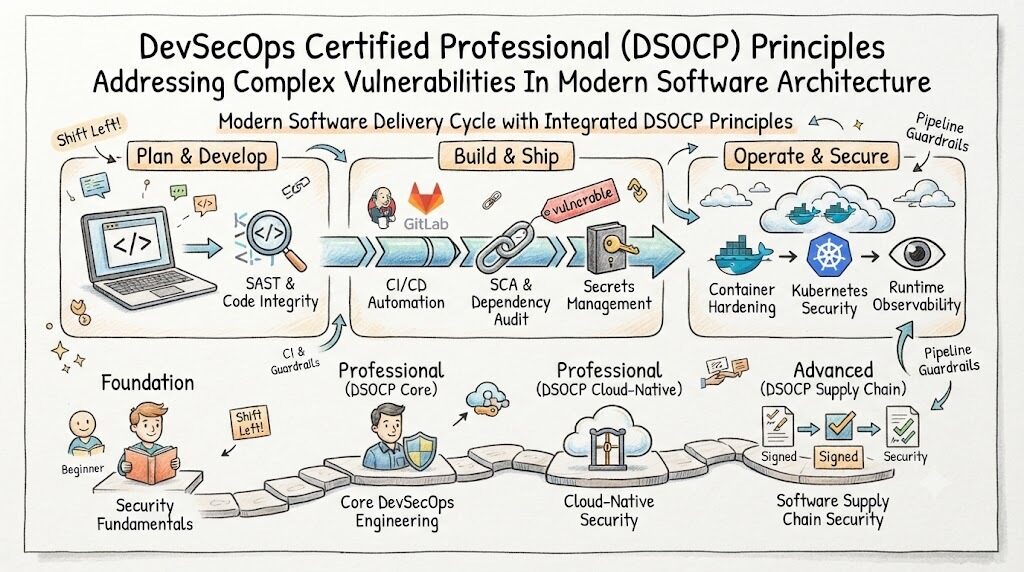
The DevSecOps Certified Professional (DSOCP) is an industry-aligned credential designed to validate an engineer's capability to bridge the gap between rapid delivery pipelines and rigorous, automated cloud security. Modern enterprise infrastructure demands that security is no longer an isolated post-build audit, but an automated, continuous, and integrated discipline woven directly into infrastructure as code, continuous integration, and container runtimes. This comprehensive guide provides software engineers, systems administrators, site reliability engineers, and technical leads with an exhaustive, experience-driven blueprint for mastering security within the modern delivery lifecycle.
As development velocity accelerates through cloud-native ecosystems, security vulnerabilities introduced early in the software development lifecycle cost significantly more to remediate once deployed into production environments. Achieving proficiency through this pathway enables practitioners to transition from traditional operations or siloed security auditing into high-impact platform engineering, security architecture, and resilient systems design. Whether your background stems from operations, infrastructure management, or application engineering, this roadmap cuts through market noise to deliver a practical framework for advancing your career, implementing robust automated guardrails, and navigating enterprise delivery systems without compromising speed or operational stability.
What is the DevSecOps Certified Professional (DSOCP)?
The DevSecOps Certified Professional (DSOCP) represents a technical benchmark certifying that an engineering practitioner can seamlessly integrate automated security mechanisms across the entire Continuous Integration and Continuous Deployment (CI/CD) ecosystem. Rather than focusing on abstract compliance checklists or static theoretical security controls, this certification exists to address modern, production-focused engineering environments where deployment frequency and security rigor must coexist. It directly mirrors the daily realities of production workflows by validating an engineer's ability to identify, isolate, and remediate vulnerabilities within source repositories, container registries, build steps, and orchestrated runtime clusters.
In enterprise engineering organizations, security teams have traditionally operated as external friction points, introducing operational bottlenecks right before scheduled release windows. The DevSecOps Certified Professional (DSOCP) fundamentally addresses this organizational challenge by cultivating practitioners who automate security checks directly within source code management systems, build systems, artifact repositories, and runtime platform fabrics. By focusing on hands-on tools, infrastructure automation, policy enforcement frameworks, and continuous monitoring pipelines, it aligns practitioners directly with high-velocity agile delivery methodologies and cloud-native standards.
Who Should Pursue DevSecOps Certified Professional (DSOCP)?
The DevSecOps Certified Professional (DSOCP) is specifically built for technical professionals responsible for building, deploying, securing, and maintaining scalable modern platforms. Software developers looking to write secure, clean code without breaking delivery schedules will gain immediate architectural clarity on pipeline vulnerabilities, dependency checks, and supply chain security. Cloud engineers, systems administrators, and DevOps specialists will discover how to embed proactive defensive patterns, secrets management systems, and dynamic verification scanners directly into their daily pipeline automation workflows.
For dedicated security analysts, penetration testers, and compliance personnel, this program serves as an essential bridge to understanding code repositories, automated build triggers, container schedulers, and modern cloud platform dynamics. Site Reliability Engineers (SREs) and platform architects benefit by gaining actionable mechanisms to ensure that system reliability is not compromised by unpatched vulnerabilities or misconfigured identity layers. Across major technology hubs in India, North America, Europe, and the Asia-Pacific region, enterprise technology teams actively seek professionals who understand how to harmonize velocity, reliability, and security across distributed cloud footprints.
Why DevSecOps Certified Professional (DSOCP) is Valuable Today and Beyond
Enterprise digital architecture has decisively transitioned from monolithic, on-premises data centers to distributed microservices, multi-cloud platforms, and containerized architectures. In this decoupled landscape, the traditional perimeter defense model is entirely obsolete, leaving applications and underlying infrastructure components directly exposed to continuous automated attacks. Organizations face strict regulatory environments, complex data protection mandates, and increasingly sophisticated supply chain vulnerabilities that cannot be resolved using quarterly manual code reviews or ad-hoc vulnerability scans.
Investing personal time and focus into the DevSecOps Certified Professional (DSOCP) yields substantial, enduring career returns because it decouples an engineer's value from individual, transient tools and centers it on architectural methodologies. While pipeline runners and scanning utilities will naturally evolve, the fundamental engineering logic of shift-left vulnerability mitigation, immutable infrastructure hardening, dynamic runtime tracing, and automated policy validation remains constant across the industry. Professionals holding these proven competencies maintain a distinct competitive advantage, securing strategic platform and architecture roles while remaining resilient to shifting technology cycles.
DevSecOps Certified Professional (DSOCP) Certification Overview
The DevSecOps Certified Professional (DSOCP) program is administered as an intensive, hands-on learning and credentialing journey delivered through dedicated digital platforms and rigorous evaluation frameworks. Unlike multiple-choice exams that prioritize memorization of syntax or terminology, the assessment approach focuses on demonstrating functional competence across realistic infrastructure sandboxes and containerized pipelines. Candidates are expected to debug compromised pipelines, configure active security monitors, correct misconfigured access topologies, and implement automated vulnerability gates within continuous delivery systems.
The program's underlying curriculum is engineered by seasoned enterprise practitioners, ensuring that candidate evaluations match the actual operational problems encountered inside large-scale cloud operations. It encompasses progressive instructional tiers, bridging essential systems fundamentals with highly granular platform hardening techniques and enterprise governance architectures. By maintaining strict operational testing standards, the certification guarantees that credentialed engineers possess verified, production-ready capabilities capable of immediately resolving high-severity threats within corporate continuous delivery networks.
DevSecOps Certified Professional (DSOCP) Certification Tracks & Levels
The certification structure follows a structured maturity curve that systematically scales from core delivery mechanics to advanced enterprise governance and runtime orchestration:
Foundation Level: Targets early-career engineers, operations specialists, and support analysts looking to establish core literacy in automated continuous deployment workflows, security terminology, baseline Git operations, and early shift-left principles.
Professional Level (DSOCP Core): Focuses on practicing DevOps engineers, platform administrators, and security specialists who must actively write pipeline code, implement vulnerability scanners, enforce container hardening, manage distributed secrets, and build automated release gates.
Advanced Level: Tailored for principal engineers, enterprise security leads, and platform directors who architect zero-trust cloud meshes, establish organization-wide compliance as code frameworks, and orchestrate runtime behavioral security across distributed Kubernetes environments.
Specialization tracks connect foundational platform engineering directly to allied disciplines such as Site Reliability Engineering, Financial Operations, and intelligent platform monitoring, allowing engineers to construct a balanced, versatile technical skill set.
Complete DevSecOps Certified Professional (DSOCP) Certification Table
| Track | Level | Who it’s for | Prerequisites | Skills Covered | Recommended Order |
| Security & Delivery Core | Foundation | Junior DevOps engineers, QA analysts, systems administrators | Basic Linux, shell scripting, fundamental Git concepts | Git workflow security, introductory CI/CD, basic scanning tools, pipeline concepts | 1 |
| DevSecOps Engineering | Professional (DSOCP) | Mid-to-senior DevOps engineers, cloud administrators, security analysts | Practical CI/CD experience, container basics, cloud architecture knowledge | SAST, DAST, SCA dependency scanning, secrets management, Docker hardening | 2 |
| Cloud-Native Platform | Advanced | Platform engineers, senior SREs, infrastructure security architects | Multi-cluster Kubernetes knowledge, production cloud infrastructure administration | Kubernetes security, service mesh mTLS, runtime detection, policy-as-code | 3 |
| SRE & Resilience | Professional | Site reliability engineers, operations leads, performance testers | Systems administration, monitoring basics, reliability concepts | Chaos security engineering, vulnerability-driven SLOs, automated incident response | 4 |
| Governance & Architecture | Advanced | Engineering managers, security directors, enterprise architects | Senior engineering leadership, enterprise security frameworks | Compliance-as-code, supply chain attestation, risk scoring, cloud security auditing | 5 |
Detailed Guide for Each DevSecOps Certified Professional (DSOCP) Certification
DevSecOps Certified Professional (DSOCP) – Foundation Level
What it is
The Foundation Level validates an engineer's operational understanding of baseline software delivery mechanics, modern security jargon, and foundational automation patterns. It confirms that a practitioner understands where vulnerabilities originate within the development lifecycle and how standard pipeline stages can be instrumented to catch insecure configurations before deployment.
Who should take it
This credential suits junior software developers, systems administrators transitioning toward cloud operations, manual software test engineers, and technical project coordinators seeking foundational literacy in automated platform security workflows.
Skills you’ll gain
Automated version control security, commit signing, and branch protection strategies
Core Continuous Integration execution models and automated pipeline stage orchestration
Foundational vulnerability concepts across common software dependencies and system libraries
Basic Static Application Security Testing (SAST) execution within automated builders
Baseline Linux system hardening, file permission management, and secure remote shell access
Real-world projects you should be able to do
Construct a basic automated build pipeline that halts automatically upon finding insecure hardcoded credentials in source code.
Configure a localized code repository with automated pre-commit scanning hooks to prevent unauthorized credential check-ins.
Execute automated software component analysis across third-party open-source code packages within an active build script.
Preparation plan
7–14 Days Strategy: Spend two to three hours daily reviewing modern pipeline architectures, Git workflows, and common application security vulnerabilities while running standard open-source linting scripts locally.
30 Days Strategy: Build automated test pipelines from scratch using basic CI servers, integrating static scanning utilities, and writing custom shell scripts to parse and evaluate scanner outputs.
60 Days Strategy: Combine comprehensive operating system administration studies with automated pipeline builds, systematically dissecting common vulnerability reports and documenting remediation methods.
Common mistakes
Memorizing security tool names and marketing definitions without understanding their underlying scan mechanics.
Ignoring basic Linux security models, permission structures, and environment variable isolation principles.
Relying exclusively on graphical user interface tools instead of developing pipeline-driven command-line automation.
Best next certification after this
Same-track option: DevSecOps Certified Professional (DSOCP) – Professional Core Level
Cross-track option: Certified Kubernetes Administrator (CKA)
Leadership option: Agile Project Management Foundation
DevSecOps Certified Professional (DSOCP) – Professional Core Level
What it is
The Professional Core Level evaluates an engineer's capacity to design, build, maintain, and enforce robust automated security architectures directly inside real-world continuous deployment workflows. It confirms end-to-end expertise across vulnerability scanning, artifact signing, secrets rotation, and container runtime hardening.
Who should take it
Mid-to-senior cloud engineers, DevOps practitioners, infrastructure specialists, systems developers, and platform automation engineers who directly manage continuous delivery pipelines and containerized applications.
Skills you’ll gain
Comprehensive integration of SAST, DAST, and SCA tooling into multi-branch delivery pipelines
Enterprise secrets management, dynamic token issuance, and secure injection into distributed containers
Dockerfile hardening, multi-stage minimal build patterns, and image vulnerability scanning
Automated policy enforcement, admission control rules, and security threshold gating
Continuous infrastructure-as-code security scanning, misconfiguration identification, and drift monitoring
Real-world projects you should be able to do
Build an end-to-end continuous integration pipeline featuring automated code analysis, dependency inspection, container vulnerability checks, and dynamic artifact gating.
Deploy a centralized enterprise secrets vault, configuring automatic credential rotation and injection into containerized microservices without touching the disk.
Implement static infrastructure scanning over declarative templates to block the provisioning of public-facing storage buckets and insecure network security groups.
Preparation plan
7–14 Days Strategy: Focus exclusively on end-to-end pipeline creation, running parallel SAST, DAST, and container scanning configurations across automated runner instances.
30 Days Strategy: Configure an automated CI pipeline connected to a secrets management system; write declarative policies to block builds exceeding specific common vulnerability scoring thresholds.
60 Days Strategy: Construct a comprehensive microservices delivery pipeline covering source scanning, minimal container creation, registry signing, policy validation, and automated rollback triggers.
Common mistakes
Setting up security scanning tools that generate thousands of unprioritized false positives, causing build pipelines to fail continuously and frustrating engineering teams.
Storing sensitive credentials, API keys, or certificates within environment variables or container layers instead of utilizing isolated secrets engines.
Neglecting Dynamic Application Security Testing (DAST) configurations in favor of purely static code analysis.
Best next certification after this
Same-track option: DevSecOps Certified Professional (DSOCP) – Advanced Platform Level
Cross-track option: Certified Kubernetes Security Specialist (CKS)
Leadership option: Certified Information Systems Security Officer (CISSO)
DevSecOps Certified Professional (DSOCP) – Advanced Platform Level
What it is
The Advanced Platform Level validates mastery over complex cloud-native architectures, runtime behavioral monitoring, automated platform policy governance, and multi-tenant container orchestration security. It certifies an engineer's readiness to design highly resilient, self-defending platform infrastructure.
Who should take it
Principal platform engineers, enterprise cloud security architects, senior site reliability leads, and infrastructure consultants managing complex multi-cluster microservices fabrics.
Skills you’ll gain
Advanced Kubernetes cluster hardening, API server protection, and runtime admission controller architecture
Cloud-native policy-as-code design, validation, and enforcement across hybrid infrastructures
Behavioral runtime security inspection, threat profiling, and automated system call analysis
Zero-trust network segmentation, service mesh mutual TLS implementation, and identity assertion
Software bill of materials (SBOM) generation, automated cryptographic artifact signing, and provenance verification
Real-world projects you should be able to do
Deploy a Kubernetes policy enforcement engine that dynamically evaluates incoming cluster payloads and prevents root-privileged workloads from deploying.
Configure runtime behavioral sensors across an active cluster to detect, trace, and isolate processes attempting unauthorized system file tampering.
Design a comprehensive software supply chain pipeline that produces an attested software bill of materials and verifies cryptographic provenance prior to deployment.
Preparation plan
7–14 Days Strategy: Dedicate focused laboratory time to admission control frameworks, running custom policy rules against diverse, intentionally flawed workload manifests.
30 Days Strategy: Set up multi-node Kubernetes clusters, deploy runtime behavioral detection tools, simulate runtime escape techniques, and configure alerting webhooks.
60 Days Strategy: Architect an enterprise-grade cloud-native ecosystem featuring automated policy enforcement, service mesh mutual TLS, supply chain verification, and continuous infrastructure compliance audit hooks.
Common mistakes
Treating runtime platform protection identically to build-time pipeline security instead of recognizing dynamic runtime behaviors.
Neglecting to test policy-as-code rules within non-blocking audit modes before moving directly to hard enforcement, resulting in broken platform deployments.
Overlooking identity assertion and internal network segmentation under the assumption that internal cluster networks are inherently secure.
Best next certification after this
Same-track option: DevSecOps Certified Enterprise Architect
Cross-track option: Certified Cloud Security Professional (CCSP)
Leadership option: DevSecOps Leadership and Executive Governance Master
Choose Your Learning Path
DevOps Path
The standard DevOps path establishes the engineering core of automated continuous integration, continuous delivery, infrastructure provisioning, and collaborative tooling. This path focuses on accelerating release frequency, automating code deployments, and eliminating manual handoffs across development and infrastructure operations. Engineers mastering this track build deep competence in source control orchestration, automated artifact management, and resilient delivery lifecycles. It provides the essential operational foundation required to understand how software moves from a developer's workstation into live enterprise environments.
DevSecOps Path
The DevSecOps path layers defensive security tooling, risk governance, secrets isolation, and automated validation gates directly on top of modern delivery mechanics. This path emphasizes that security cannot act as an afterthought, but must operate as a seamless, automated, and continuous discipline within development and deployment loops. Engineers following this curriculum master the integration of automated static scanners, dependency checkers, container hardening patterns, and runtime detection mechanisms. It empowers practitioners to eliminate systemic vulnerabilities while maintaining rapid continuous delivery cadences.
SRE Path
The Site Reliability Engineering path anchors delivery architectures to resilience, observable telemetry, distributed tracing, and service level objective enforcement. This path teaches engineers how to manage operational complexity, automate system recovery, conduct deep post-mortem analysis, and maintain uptime within complex cloud systems. It challenges engineers to look at platform security through the lens of availability, ensuring that security patches and controls do not inadvertently degrade system responsiveness. Practitioners gain mastery over automated failover, chaos testing protocols, and operational stability.
AIOps Path
The AIOps path leverages machine learning heuristics, anomaly detection frameworks, and automated telemetry analytics to manage modern infrastructure systems. This path teaches platform engineers how to ingest high-volume telemetry streams, filter out noisy alerts, and isolate root causes across interconnected microservices environments. Practitioners gain direct capabilities in configuring event correlations, training baseline behavioral models, and establishing automated platform self-healing scripts. It equips technical professionals to manage sprawling multi-cloud environments that have grown far too complex for traditional manual oversight.
MLOps Path
The MLOps path adapts continuous delivery and automated operational engineering principles directly to machine learning training, validation, and serving lifecycles. This specialized track focuses on maintaining reliable model training pipelines, feature store automation, versioned datasets, and containerized inference endpoints. Engineers learn to mitigate unique risks, including model drift, training data poisoning, and unauthorized parameter adjustments within live systems. By securing and automating model deployment lifecycles, practitioners ensure enterprise artificial intelligence systems deploy predictably and securely.
DataOps Path
The DataOps path applies agile delivery mechanics, continuous automated testing, and infrastructure orchestration directly to distributed data transformation networks. This path focuses on improving data quality, managing access control across analytical data lakes, and automating complex extraction, transformation, and load pipelines. Practitioners learn to implement automated schema validations, verify data pipelines across distributed storage layers, and enforce encryption policies across data in motion and at rest. It provides data platform engineers with the tools needed to scale analytics operations without sacrificing governance.
FinOps Path
The FinOps path introduces operational financial accountability, automated resource optimization, and infrastructure usage governance to continuous cloud systems. This track focuses on aligning platform engineering decisions with business spending targets, breaking down complex multi-cloud billing structures, and building transparent cost metrics. Practitioners learn to configure automated workload rightsizing, detect unallocated resource waste, and construct real-time visibility dashboards for engineering and finance teams. It empowers engineers to build lean, cost-efficient cloud architectures that maximize enterprise return on technology investments.
Role to Recommended DevSecOps Certified Professional (DSOCP) Certifications
| Role | Foundation Level | Professional Level (DSOCP) | Advanced Platform Level |
| DevOps Engineer | Recommended | Primary Focus | Next Progression |
| SRE | Optional | Primary Focus | Strongly Recommended |
| Platform Engineer | Optional | Primary Focus | Primary Focus |
| Cloud Engineer | Recommended | Primary Focus | Optional |
| Security Engineer | Optional | Primary Focus | Strongly Recommended |
| Data Engineer | Recommended | Optional | N/A |
| FinOps Practitioner | Recommended | Optional | N/A |
| Engineering Manager | Primary Focus | Recommended | Strategic Overview |
Next Certifications to Take After DevSecOps Certified Professional (DSOCP)
Same Track Progression
Once you have fully mastered the core practices of the DevSecOps Certified Professional (DSOCP), your logical next step is deep enterprise specialization across cloud-native platforms, runtime threat engineering, and zero-trust systems design. Moving toward specialized credentials such as advanced cloud security architect programs or certified Kubernetes security credentials allows you to address the most complex runtime operational challenges. This progression equips you to design self-defending infrastructure, architect enterprise-wide automated policy frameworks, and secure dynamic service meshes. By establishing this level of deep specialization, you step beyond pipeline maintenance to shape the core engineering standards of modern digital platforms.
Cross-Track Expansion
Platform engineering does not exist in an architectural vacuum, and true technical leaders regularly diversify their competencies into adjacent operational domains. Pursuing cross-track credentials across Site Reliability Engineering, advanced Kubernetes orchestration, and cloud cost management dramatically rounds out your infrastructure profile. Understanding how automated security decisions directly impact platform availability, recovery metrics, and monthly cloud expenditures allows you to design balanced, production-ready systems. This multi-disciplinary versatility enables you to collaborate effectively across isolated engineering teams, resolving conflicting organizational goals smoothly.
Leadership & Management Track
For senior practitioners planning a transition from hands-on execution into strategic management, your next phase shifts toward enterprise governance, technical leadership, and risk management. Advancing into credentials such as certified enterprise information systems management or high-level cloud governance programs sharpens your ability to align engineering standards with overarching business strategy. This progression focuses on managing engineering talent, setting security budgets, communicating operational risks to executive stakeholders, and steering digital transformation initiatives. It transforms highly capable technical contributors into visionary engineering managers and platform directors.
Training & Certification Support Providers for DevSecOps Certified Professional (DSOCP)
DevOpsSchool
DevOpsSchool is a well-known technical training institution delivering specialized programs in DevOps, DevSecOps, SRE, and cloud-native platform engineering. The platform emphasizes deep, hands-on enterprise workshops led by veteran industry practitioners who bring decades of real-world infrastructure experience into the virtual classroom. Candidates benefit from comprehensive course material, end-to-end practical labs, and production-grade project scenarios designed to mirror modern corporate technical challenges. Their structured curriculum assists engineers in mastering pipeline security, continuous testing, and infrastructure automation, ensuring learners transition smoothly from conceptual understanding to verified workplace competence across global enterprise environments.
Cotocus
Cotocus operates as an agile IT consulting and workforce enablement provider, specializing in cutting-edge digital transformation practices and enterprise engineering frameworks. Their educational programs are built around real-world deployment challenges, helping engineering teams and individuals implement modern containerization, security automation, and cloud delivery pipelines. By providing personalized mentoring and hands-on lab environments, Cotocus helps engineers master complex platform engineering tools, shift-left testing methodologies, and distributed system architectures. Their industry-tailored corporate training models make them an effective choice for organizations looking to upskill technical staff in automated security workflows.
Scmgalaxy
Scmgalaxy is an established community portal and training hub that has supported software configuration management, build engineering, and DevOps professionals for over a decade. The platform offers rich technical repositories, instructional guides, and structured courses covering version control operations, release management, continuous integration systems, and DevSecOps patterns. Driven by a passionate community of technical contributors, Scmgalaxy provides accessible, practical education for engineers seeking to transition from legacy system administration into modern platform automation. Their practical exercises emphasize resolving operational bottlenecks, maintaining code hygiene, and deploying reliable delivery pipelines across diverse technology stacks.
BestDevOps
BestDevOps functions as an educational resource center and specialized training platform dedicated to advancing modern systems architecture and delivery methodologies. It provides in-depth technical analysis, clear career roadmaps, and hands-on training courses tailored to developers, system administrators, and infrastructure managers. The platform focuses heavily on practical, tool-agnostic engineering fundamentals, guiding learners through automated continuous delivery, secrets protection, container scanning, and platform observability frameworks. With clean instructional material and targeted laboratory modules, BestDevOps enables practitioners to build confidence in configuring production platforms while aligning with modern enterprise security standards.
devsecopsschool.com
devsecopsschool.com is a dedicated technical training institution created specifically to advance security automation within modern engineering workflows. The organization addresses the growing demand for automated application testing, continuous security monitoring, and secure continuous delivery pipelines by offering highly targeted, lab-intensive training tracks. Instructors focus heavily on real-world implementation, teaching students how to instrument SAST, DAST, SCA, and runtime defenses into popular CI/CD systems without causing pipeline delays. Engineers completing their courses gain practical, verifiable skills in vulnerability remediation, container image hardening, and policy-as-code enforcement across multi-cloud environments.
sreschool.com
sreschool.com focuses exclusively on the disciplines of Site Reliability Engineering, distributed systems resilience, and enterprise platform availability. The platform equips systems engineers and platform administrators with the tools and techniques needed to design fault-tolerant microservices, enforce service level objectives, and automate incident responses. Through hands-on scenarios involving chaos testing, automated observability, and infrastructure healing, students learn to maintain rock-solid reliability across highly scaled production systems. Their targeted courses show how to integrate essential security practices alongside uptime objectives, ensuring that platform performance and defensive hardening work in unison.
aiopsschool.com
aiopsschool.com delivers focused educational programs exploring the intersection of modern platform operations and machine learning analytics. The platform helps operations engineers and infrastructure specialists understand how to collect, aggregate, and analyze massive volumes of system telemetry, logs, and performance metrics using automated machine learning frameworks. By learning how to set up intelligent alerting mechanisms, automated anomaly detection, and self-healing infrastructure patterns, students prepare themselves to manage sprawling enterprise multi-cloud setups. The curriculum provides practical insights into cutting operational noise and troubleshooting complex system failures quickly.
dataopsschool.com
dataopsschool.com is an educational platform designed to bring modern agility, continuous automated testing, and operational discipline to distributed data pipelines. Recognizing the unique challenges of data engineering, the platform teaches technical professionals how to treat data assets, extraction routines, and analytic workflows with the same automated rigor found in modern platform operations. Courses cover automated data validation, access controls, distributed pipeline orchestration, and continuous infrastructure configuration for large-scale data lakes and warehouses. Their curriculum enables data practitioners to deliver clean, secure, and highly reliable data platforms to enterprise decision-makers.
finopsschool.com
finopsschool.com focuses entirely on the critical financial discipline of cloud financial management, workload optimization, and infrastructure economics. The platform bridges the traditional communication gap between platform engineering teams, financial planners, and executive leadership by teaching engineers how to build transparent, cost-efficient cloud architectures. Students learn practical techniques for analyzing multi-cloud billing datasets, detecting unallocated resource waste, automating workload down-scaling, and setting up actionable cost governance dashboards. By mastering these competencies, technical professionals ensure that their engineering architectures remain economically sound while scaling smoothly to meet business demands.
Frequently Asked Questions (General)
1. What is the fundamental difference between regular DevOps and DevSecOps certifications?
Traditional DevOps certifications primarily focus on release automation speed, infrastructure provisioning, continuous deployment pipelines, and collaborative workflows between development and operations teams. DevSecOps certifications expand this scope by requiring that security scanning, dependency vulnerability checks, secrets management, and compliance validations are automated directly into those delivery mechanisms. The objective is to make security a shared, automated continuous responsibility rather than an isolated, manual audit performed at the end of the delivery cycle.
2. How difficult is the DevSecOps Certified Professional (DSOCP) exam for beginners?
The exam presents a moderate to high difficulty level for absolute beginners who lack hands-on experience with Linux administration, command-line operations, and basic pipeline syntax. Because the assessment focuses on functional scenarios rather than pure theoretical recall, candidates without hands-on pipeline experience will find it challenging. However, professionals who spend sufficient time working through hands-on laboratory exercises and setting up automated tools can master the necessary skills within a few months of focused study.
3. What are the core prerequisites required before starting this certification path?
Candidates should possess a working knowledge of baseline Linux system administration, shell scripting, Git version control workflows, and fundamental networking concepts. Familiarity with basic container virtualization concepts and exposure to at least one continuous integration tool or cloud environment is highly recommended. You do not need to be a senior software developer, but you must be comfortable reading code syntax, reviewing configuration files, and debugging command-line errors.
4. How much time should a working professional dedicate to prepare properly?
A working professional with baseline infrastructure or development experience should plan to dedicate between five to eight hours per week over a period of eight to twelve weeks. This cadence allows ample time to digest conceptual architectural patterns, work through practical terminal-based exercises, and troubleshoot broken pipeline builds. Experienced engineers already working directly with CI/CD platforms can typically shorten this timeline to four to six weeks of targeted preparation.
5. What is the expected return on investment (ROI) after achieving this credential?
Professionals who earn this certification often see significant career benefits, including eligibility for high-demand roles such as Platform Security Engineer, DevSecOps Engineer, and Cloud Security Architect. These positions generally command higher compensation than traditional systems administration or general support roles. Beyond financial rewards, the credential equips engineers to solve critical delivery problems, directly increasing their technical impact and organizational value within modern enterprise environments.
6. In what order should an engineer pursue these related certifications?
A practical progression begins with core Linux, Git, and networking fundamentals, followed by foundational CI/CD automation practices. Once these basics are solid, candidates should tackle the core DevSecOps Certified Professional (DSOCP) to master shift-left pipeline security and container hardening. From there, engineers can pursue advanced specializations such as Kubernetes platform security, Site Reliability Engineering, or high-level enterprise cloud security architecture based on their desired career trajectory.
7. Can an engineer with only a software development background clear this certification?
Yes, software engineers can certainly clear this certification, and their ability to read, write, and refactor application code provides a distinct advantage when interpreting static analysis reports. However, application developers will need to spend extra time learning infrastructure-as-code concepts, container runtime networking, Linux system permissions, and build-runner hosting configurations. Broadening their perspective to cover these operational mechanics ensures they pass the functional scenario evaluations successfully.
8. Can a traditional security analyst transition into DevSecOps using this pathway?
Yes, this pathway serves as an ideal bridge for traditional security analysts, penetration testers, and compliance personnel looking to become hands-on platform engineers. Security professionals often possess deep theoretical risk knowledge, but they may lack direct experience with automated build pipelines, code repositories, and container orchestration platforms. This program provides the practical coding and automation skills required to transform abstract security policies into automated pipeline gates.
9. Are hands-on terminal sandbox environments included during the certification testing?
Yes, the testing structure emphasizes practical, performance-based tasks delivered within live, hosted terminal environments. Candidates are evaluated on their ability to inspect real codebases, identify security flaws, reconfigure automated build pipelines, secure misconfigured container deployments, and verify runtime policies. This real-world evaluation approach ensures that certified professionals possess the troubleshooting skills necessary to operate successfully within live enterprise environments.
10. How long does the DevSecOps Certified Professional (DSOCP) credential remain valid?
The certification credential is valid for three years from the date of issuance, reflecting the rapid pace of technological change across the cloud-native ecosystem. To maintain active certified status, practitioners can either pass the updated version of the examination or complete approved continuing professional education credits through advanced specializations. This requirement ensures that credentialed engineers stay current with emerging vulnerabilities, tools, and defensive methodologies.
11. Does the curriculum focus on proprietary commercial tools or open-source software?
The curriculum focuses primarily on widely adopted open-source utilities and cloud-native computing foundation standards, supplemented by industry-standard enterprise frameworks. By emphasizing open-source platforms, the program ensures that the underlying architectural skills, scanning concepts, and automation techniques remain completely portable across diverse corporate environments. Engineers learn the mechanics behind security tools rather than becoming locked into single-vendor platforms.
12. How does this credential assist organizations preparing for formal compliance audits?
Engineers trained under this framework learn how to implement compliance-as-code and establish continuous automated auditing throughout their delivery platforms. By generating automated software bills of materials, maintaining cryptographic commit integrity, and logging automated scan results, the platform naturally produces the continuous evidence required by regulatory standards. This shift eliminates the frantic, manual evidence-gathering drills typically associated with annual compliance audits.
FAQs on DevSecOps Certified Professional (DSOCP)
1. What specific types of automated security testing are covered within the core DSOCP syllabus?
The syllabus delivers extensive, hands-on instruction across Static Application Security Testing (SAST), Dynamic Application Security Testing (DAST), and Software Composition Analysis (SCA). Candidates learn how to configure automated scanners to inspect proprietary source code for common logic flaws, scan running web containers for dynamically exploitable vulnerabilities, and analyze third-party libraries for open vulnerabilities and licensing issues. The training places particular emphasis on tuning these utilities to eliminate noisy false positives, ensuring that automated release pipelines complete quickly without disrupting developer productivity.
2. How does the DSOCP program teach secrets management within automated build systems?
The certification covers the architecture, deployment, and practical operation of centralized secrets management systems within automated environments. Candidates learn how to avoid the dangerous practice of hardcoding API keys, database credentials, or certificates directly into version control systems or container layers. The course demonstrates how to generate dynamic, short-lived credentials, inject secrets securely into container memory at runtime, and establish automatic rotation policies. These methods ensure that even if an infrastructure layer is compromised, sensitive credentials are not exposed to attackers.
3. Does the DSOCP certification cover container and Docker image security?
Container hardening is a core pillar of the DSOCP educational framework. The curriculum covers best practices for writing secure Dockerfiles, leveraging multi-stage builds to create minimal production images, and running processes under non-privileged system users. Students learn how to scan base images for vulnerabilities, store trusted artifacts in secure private registries, and sign images cryptographically. These practices ensure that container images deployed into production are free from known exploits and have not been altered in transit.
4. How does the DSOCP curriculum handle Kubernetes and cloud-native orchestration security?
The program addresses cloud-native platform security by teaching engineers how to harden orchestrators against common attacks. Learners explore role-based access control (RBAC), pod security standards, network segmentation, and automated policy-as-code frameworks. The curriculum covers admission controllers to block non-compliant workloads before they run, alongside behavioral runtime monitoring tools to detect unauthorized process executions or file system tampering within running pods. These methods ensure robust defense across containerized microservices platforms.
5. What is the policy-as-code framework taught in the DSOCP learning modules?
The program teaches policy-as-code by demonstrating how to write, test, and enforce governance rules using declarative policy engines. Instead of relying on manual security reviews, candidates write structured code policies that evaluate infrastructure-as-code templates, container manifests, and cloud configurations. These automated rules can block unencrypted storage volumes, prevent open inbound ports, and enforce access restrictions across cloud environments. This approach allows security teams to scale their governance across multi-cloud footprints automatically.
6. How does the DSOCP program address software supply chain security and SBOM management?
Supply chain security is a key focus of the advanced curriculum, addressing modern threats targeting development and delivery tools. Students learn how to generate, inspect, and sign automated Software Bills of Materials (SBOM) for containerized and compiled applications. The course covers verifying third-party build actions, ensuring cryptographic commit authenticity, and enforcing artifact provenance across registries. These skills ensure that organizations deploy verified software components, protecting their deployment pipelines from supply chain tampering.
7. How are dynamic application tests (DAST) integrated into fast CI/CD pipelines without causing delays?
The DSOCP program shows candidates how to run automated dynamic application tests efficiently against ephemeral staging environments. Students learn how to trigger focused, baseline functional security scans against temporary builds rather than attempting full, hours-long penetration tests on every commit. The course covers running comprehensive, deeply authenticated vulnerability scans asynchronously on scheduled off-peak builds. This balance allows development teams to maintain fast delivery cadences while still catching runtime vulnerabilities early in the release process.
8. How does earning the DSOCP credential help an engineer collaborate better with software development teams?
The DSOCP credential equips platform engineers to work constructively with development teams by focusing on actionable, low-friction security practices. Instead of simply forwarding long, unprioritized vulnerability spreadsheets, certified engineers learn how to embed automated scanning feedback directly into developer tools and pull requests. They configure scanning gates with tuned vulnerability thresholds, supply clear remediation guidance, and offer pre-secured base container images. This collaborative approach removes friction between security and engineering teams, accelerating secure software delivery.
Final Thoughts: Is DevSecOps Certified Professional (DSOCP) Worth It?
Making a deliberate investment in your professional education requires balancing the effort, time, and financial cost against the real impact it will have on your daily work. The industry is full of credentials that test little more than your ability to memorize product documentation, leaving you unprepared when faced with complex issues on a production cluster. The DevSecOps Certified Professional (DSOCP) stands out because it focuses directly on the daily realities of platform engineering: handling messy build scripts, resolving unpatched dependencies, isolating credentials, and keeping deployment pipelines moving smoothly.
If your daily work involves maintaining cloud infrastructure, supporting release pipelines, or securing modern platforms, the hands-on competencies verified by this program offer immediate, practical value. Rather than treating security as a theoretical compliance exercise, this pathway gives you the skills to design, automate, and defend resilient platforms under continuous delivery demands. When approached as a hands-on learning journey rather than a simple badge to collect, it provides the architectural foundation, practical skills, and versatility needed to thrive in modern software engineering.