Practical Ways Engineering Teams Balance Rapid Feature Releases With Continuous System Uptime
What Is SRESchool.com?
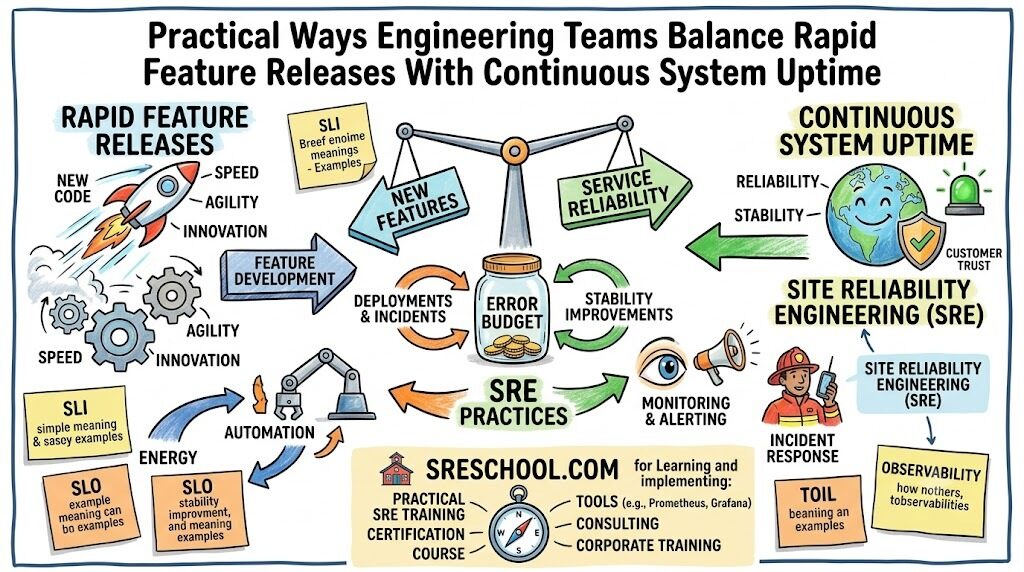
Reliability engineering views old infrastructure problems as software puzzles waiting for code solutions. Picture a home light switch that turns on bright bulbs every single time. Good reliability ensures your web application answers every click without stalling. SRE helps technology teams maintain rock-solid services across all digital platforms. Engineers track real performance numbers around the clock with automated checks. They design instant notifications that catch strange glitches before users see them. Teams write smart scripts to wipe out boring manual jobs forever. Later, teammates study system hiccups together to improve future operations.
Why Does SRESchool.com Matter?
Every modern business depends on cloud machines, deep databases, and large network routers. A single bad line of code can freeze a digital hospital portal instantly. Thousands of sick patients lose vital medical records during such an outage. SRE avoids these costly disasters through disciplined tracking and proactive code testing. Technicians resolve early warning signals before small flaws cause widespread service interruptions. Organizations protect their hard-earned money when their cloud servers stay live. Smart companies make operational health a primary concern from their very first day.
What Does an SRESchool.com Team Do?
Engineers on an SRE team protect live platforms through various crucial responsibilities. They watch system dashboards to observe server memory, traffic, and disk space. Meanwhile, automated monitors ping designated engineers whenever a server memory leak occurs. The assigned responder investigates the issue and repairs the break right away. Team members design custom scripts that take over tedious server chores automatically. They forecast future computer capacity so upcoming traffic surges never overwhelm databases. Furthermore, they examine architectural blueprints to remove single points of failure. Afterwards, they draft blameless postmortems to teach the whole company better habits.
Key SRE Terms Made Easy
Tech workers use a handful of important acronyms to describe production stability. A Service Level Indicator, or SLI, records the exact speed or availability metric. A Service Level Objective, or SLO, states the target standard your team targets. An Error Budget marks the exact slice of downtime your service tolerates. Toil covers repetitive human work that simple computer code can finish. Observability gives specialists clear visibility into inner software events via telemetry data. On-call rotations assign ready responders to handle late-night server emergencies promptly. Finally, an incident names an unexpected drop in system performance.
| SRE Term | Simple Meaning | Example |
| SLI | A direct measure of system health | The portal returns results in 200 milliseconds |
| SLO | The reliability benchmark teams promise | Maintain 99.5 percent uptime this quarter |
| Error Budget | The allowable room for minor failures | We can spend twenty minutes of downtime |
| Toil | Boring manual labor repeated daily | Typing commands to clear server logs |
| Observability | Clear insight into hidden system states | Inspecting system traces to locate bottlenecks |
| Incident | An unexpected technical breakdown | The payment gateway rejects client credit cards |
What Is SRE Training?
Newcomers begin their reliability path by enrolling in beginner-friendly SRE Training. Students discover core tenets like availability benchmarks, service expectations, and risk management. Course materials teach you how to gather live telemetry and eliminate boring tasks. Instructors demonstrate how to lead emergency triage calls with steady nerves. Learners configure test cloud servers to simulate real traffic jumps and scale resources. Practical lab exercises prepare students for genuine workplace emergencies far better than lectures. Practicing real repairs on SRESchool.com grants students true operational confidence.
What Is SRE Certification?
A recognized SRE Certification tests your practical ability to maintain production clusters. A Certified Site Reliability Engineer demonstrates deep mastery of system instrumentation and rapid repair. Comprehensive evaluations verify that you understand cloud safety, automated triggers, and rollback procedures. Even so, paper credentials cannot substitute for genuine time spent running live systems. You must build tangible portfolio projects and repair intentional test breakages yourself. Technology employers value verifiable credentials alongside actual hands-on troubleshooting talent.
What Is a Site Reliability Engineering Course?
An organized Site Reliability Engineering Course guides you step-by-step through essential engineering skills. Students first review fundamentals before assembling basic operational metrics on sample nodes. Next, learners configure interactive charts to visualize server states clearly. After that, they calculate error budgets to make safe development choices. Instructors launch simulated failures so students can test their mitigation plans under pressure. Learners then develop automated programs that execute routine operational repairs safely. Eventually, participants operate complex, resilient clusters inside modern cloud platforms.
SRE Tools Made Simple
Engineers employ specialized software instruments to supervise their distributed computer systems. Data collectors like Prometheus gather raw operational counters from remote nodes. Visualizers like Grafana present those numbers through colorful, easy-to-read charts. Centralized loggers store diagnostic messages so developers can search for stack traces easily. Distributed tracers like OpenTelemetry follow individual user requests as they bounce across clusters. Alerting managers page engineers when disk space hits dangerous thresholds. Meanwhile, infrastructure automation tools run system updates across hundreds of virtual instances.
| Learning Area | What Learners Can Practice |
| Metric Collection | Pull server stats using Prometheus |
| Visual Monitoring | Construct dynamic dashboards with Grafana |
| Request Tracing | Follow network calls via OpenTelemetry |
| Outage Drills | Revert broken updates within simulated clusters |
| Task Automation | Write Bash scripts to prune expired files |
| Cloud Elasticity | Build automatic scaling rules for servers |
Real-Life Scenarios / Experiences
Engineers encounter unexpected challenges while maintaining live web infrastructure every day.
An e-commerce platform receives massive visitor traffic during an annual holiday sale. The reliability team spots a database bottleneck on Grafana and spins up read-only database replicas.
A developer deploys an untested code change that breaks the user account settings page. The monitoring system fires an alert, and an engineer reverts the deployment within three minutes.
A technician logs into terminal windows every afternoon to delete old temporary cache files. The team crafts a scheduled Cron job that clears the cache automatically without human help.
An undersea network cable snaps during a powerful oceanic earthquake event. Automated traffic routers immediately redirect international data packets across alternative fiber paths.
What Is SRE Consulting?
Hiring SRE Consulting partners injects elite reliability knowledge directly into your existing workforce. Skilled advisers examine your current application stack to pinpoint fragile structural spots. They assist management in defining realistic SLO targets for every microservice. Additionally, consultants tune loud alerting channels so engineers only receive notifications for real emergencies. They guide your staff through practical methods that cut down exhausting daily toil. Most importantly, advisers deliver a step-by-step roadmap for your engineers to execute over time. Your engineering culture adopts modern techniques that protect revenue-generating platforms permanently.
What Is SRE as a Service?
Emerging companies often pick SRE as a Service to gain constant platform support. External specialists guard your cloud instances day and night without requiring full-time internal hires. These experts step in immediately when production services stall outside normal work hours. They conduct periodic architecture evaluations to uncover lurking bugs and configuration drift. Furthermore, they build automated cloud scaling so your applications grow alongside your business. Organizations should outline clear support requirements before contracting external engineering teams. Transparent service expectations ensure both groups collaborate toward identical stability milestones.
What Is Corporate SRE Training?
Tailored Corporate SRE Training unites entire technical departments around cohesive operational habits. Expert coaches shape lesson plans around the specific cloud stack your organization runs daily. Developers and systems administrators practice resolving simulated outages together within isolated environments. They study consistent mathematical formulas to measure customer happiness accurately. Teams also code custom automation scripts to kill their most hated administrative tasks. Collaborative lab drills transform workplace finger-pointing into smooth, decisive incident response during live production panics.
Common Mistakes to Avoid When Choosing Reliability Methods
Technology departments frequently make expensive blunders when establishing reliability frameworks for the first time.
Teams demand zero minutes of downtime and set unreasonable one-hundred-percent uptime targets.
Engineers configure thousands of low-priority alarms that wake responders for trivial events.
Leadership ignores exhausting manual chores until top engineers hand in their resignations.
Programmers release major feature updates without validating their stability under peak user loads.
Staff hide operational mistakes instead of holding honest, blameless postmortem discussions together.
Organizations purchase flashy observability platforms without training staff to interpret the collected charts.
Technicians forget to test their disaster recovery plans until a real cloud region disappears.
Executives treat reliability as a quick, one-off goal rather than an ongoing daily habit.
How SRESchool.com Can Help
SRESchool.com offers an all-in-one educational and consulting destination for modern systems engineering. Aspiring engineers can enroll in an SRE Course to establish marketable technical qualifications. Experienced practitioners can pursue an SRE Certification to demonstrate their cloud competence to employers. The website hosts an extensive SRE Tutorial directory that explains popular SRE Tools simply. Enterprises can book Corporate SRE Training to align development and operations teams on core principles. Furthermore, businesses benefit from SRE Consulting to eliminate painful manual work. Companies can also select SRE as a Service for continuous, proactive infrastructure oversight.
Frequently Asked Questions
1. What does Site Reliability Engineering mean in plain words?
Site Reliability Engineering treats operations work as a software engineering task. Developers build automated systems to manage servers, backups, and live deployments without manual intervention. They install telemetry agents to monitor server status day and night. Whenever a server fails, engineers resolve the issue immediately. Afterward, the team studies the root cause to prevent future outages.
2. Can a complete beginner learn SRE?
Anyone can master SRE by following an organized, step-by-step learning program. You should study basic Linux commands, networking concepts, and beginner Python syntax first. Next, dive into fundamental reliability concepts like service indicators and error margins. Safe cloud sandboxes allow you to practice troubleshooting realistic failures without fear. Dedicated training paths help newcomers land exciting technology roles.
3. What is an SLO?
An SLO stands for Service Level Objective. It represents a concrete target for system uptime and performance. A company might declare that its payment gateway must process requests within two seconds. This common objective ensures that developers and operations staff aim for identical results. It keeps customers happy without demanding impossible perfection from engineers.
4. What does an Error Budget do?
An Error Budget defines the exact amount of downtime a team can burn through safely. Every complex piece of software experiences occasional hiccups or brief network pauses. If your service targets ninety-nine percent uptime, your error budget gives you one percent downtime. Developers use this wiggle room to deploy new features quickly. When the budget empties, the team halts new releases to squash bugs.
5. What is the meaning of toil in SRE?
Toil refers to repetitive, manual computer jobs that yield no lasting value. Manually restarting a stalled web server every morning is a textbook example of toil. Such manual work grows as your application attracts more users. SRE teams write automated code that finishes these boring chores without human clicks. Eliminating toil grants engineers valuable time to build creative product features.
6. What is the main difference between DevOps and SRE?
DevOps serves as a cultural philosophy that encourages coders and system administrators to collaborate. SRE provides the concrete playbook that puts those ideas into real-world action. If you think of DevOps as an overall philosophy of healthy living, SRE is your daily exercise routine. Both methodologies help technology companies ship resilient software rapidly.
7. Why do systems need observability?
Observability lets technicians see the inner mechanisms of distributed software during live execution. Basic monitoring tools simply report whether a server is dead or alive. Observability tools expose sluggish database lookups and failing backend network requests early. Engineers study logs, traces, and metrics to resolve stubborn software defects quickly. Deep observability prevents minor glitches from turning into major website outages.
8. What does being on-call mean?
Carrying an on-call pager means an engineer stays ready to address unexpected production crises. If the company portal crashes during the night, an automated pager wakes that engineer. The technician logs into the secure network and restores the broken service promptly. Teams cycle this responsibility among members so nobody experiences severe exhaustion. Thoughtful schedules protect team members from workplace burnout.
9. What happens during a postmortem meeting?
Engineers conduct a postmortem review shortly after resolving an unexpected service interruption. The whole team gathers to uncover why the technical failure happened. Team leaders forbid personal blame and focus strictly on broken software safeguards. Participants identify confusing alert triggers or flawed code paths that permitted the failure. Then, they program automated safeguards to prevent that specific bug forever.
10. Which programming languages do SREs use?
Most reliability engineers write their daily automation scripts using Python or Go. Python offers an accessible syntax that makes scripting server maintenance quick and painless. Go executes with tremendous speed and powers industry-standard cloud technologies like Kubernetes. Some specialists also write shell scripts for quick administrative chores inside Linux terminals. Mastering one of these languages provides a great starting point.
11. What is the role of an SRE consultant?
An SRE consultant acts as a specialist adviser who helps organizations stabilize fragile software platforms. These experts audit your existing cloud setups and flag severe operational bottlenecks. Consultants also train internal staff to execute clean incident response procedures. They coach executives on picking realistic, achievable reliability targets. Their strategic advice helps companies lower infrastructure bills and reduce downtime.
12. How does SRE save money for businesses?
Reliability practices save businesses enormous sums by preventing prolonged application outages. When a store website freezes, frustrated consumers take their credit cards to competing vendors. SRE also prevents wasteful cloud spending through disciplined capacity forecasting. Automation spares engineers from repetitive labor so they can engineer revenue-generating software faster. Dependable digital platforms safeguard brand loyalty and drive corporate growth.
CONCLUSION
Modern digital organizations rely on Site Reliability Engineering to keep cloud applications responsive around the clock. Combining software development techniques with operational maintenance prevents costly platform outages and user frustration. Technical teams apply service level goals, error budgets, and live telemetry to safeguard system health. Curious beginners can build essential capabilities through guided coursework, hands-on practice labs, and recognized certifications. Concurrently, expanding businesses can engage external consultants or managed services to strengthen enterprise infrastructure. Learning through SRESchool.com equips engineers and commercial teams with the exact technical skills required to build dependable software platforms.