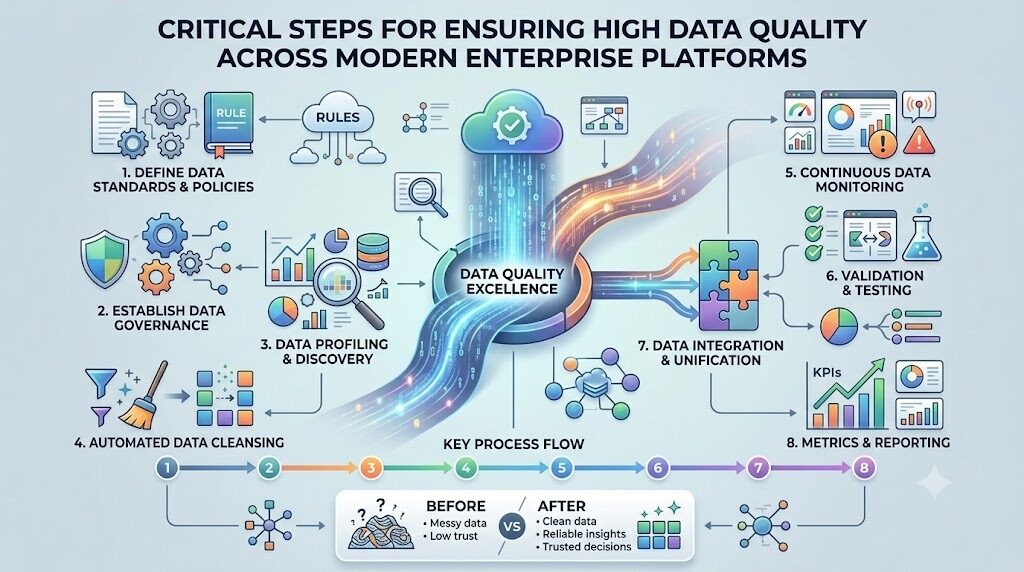
Critical Steps For Ensuring High Data Quality Across Modern Enterprise Platforms
What Is DataOps?
Think of data like water flowing through long city pipes into your home sink. If the pipes crack, mud gets inside, or water stops moving completely. DataOps keeps computer data clean, fresh, and moving fast from place to place. It brings people, smart tools, and helpful rules together to build steady pipelines. Teams test the data at every stop so bad files never slip through. Automation runs these checks fast without humans having to click buttons all day. As a result, engineers work together happily and deliver trustworthy numbers to business teams.
Why Does DataOps Matter?
Companies depend on good numbers every single minute to run their daily business. Without strong processes, workers face slow data delivery and missing numbers constantly. People type numbers by hand, which leads to silly errors and late reports. Broken pipelines cause computer systems to crash during busy work hours. Teams also argue with each other when numbers on different screens do not match. DataOps solves these common issues by setting up strong safety rails for data. Now, systems fix errors fast, work finishes on time, and managers trust their daily reports.
What Is TheDataOps.org
TheDataOps.org is a specialized knowledge hub made for learners and working data engineers. It shares clear guides on modern operations, cloud systems, and automated pipelines. Readers can discover practical advice to build steady data platforms for their daily jobs. The site explains complex engineering ideas with simple steps, helpful diagrams, and clear examples. It also guides teams on how to cut manual work and build trust in their data. Beginners can explore modern tools without feeling lost in heavy technical terms.
DataOps Training and DataOps Course
A good DataOps Course helps workers build clean data pipelines from scratch. Learners discover how Agile methods help teams ship small updates safely each week. Students practice DevOps habits like CI/CD, which means continuous integration and continuous delivery. In simple words, CI/CD automatically tests and delivers new code without breaking anything. Practical DataOps Training also teaches automated checks, cloud systems, and real-time system monitoring. Hands-on projects help students practice fixing broken pipelines before touching real business systems. Platforms like TheDataOps.org offer learning paths that guide beginners step by step toward success.
Comparison Table
| DataOps Area | Main Goal | Example Activity |
| Data Pipeline | Move data | Load daily sales data |
| Automation | Reduce manual work | Run jobs automatically |
| Testing | Find errors | Check missing values |
| Observability | Watch systems | Track failed jobs |
| Data Quality | Improve data | Check data rules |
| Orchestration | Manage steps | Run jobs in order |
DataOps Certification
A DataOps Certification helps workers prove their skills to employers and team leaders. It shows that you understand automated testing, monitoring, and steady pipeline design. But a paper certificate alone does not make someone an expert engineer. Real skill comes from writing code, testing pipelines, and solving messy data problems. A smart student starts with basic SQL, studies automation tools, and builds small sample projects. Next, they practice deploying pipelines in the cloud and study common system failures. Finally, they take the exam to validate their hard work and practical knowledge.
Data Pipeline Automation
Data Pipeline Automation stops engineers from repeating boring copy-and-paste tasks every single morning. The basic pipeline follows simple steps: Collect, Clean, Test, Process, Store, and Monitor. First, computers collect raw numbers from online stores and mobile apps. Next, scripts clean out weird symbols and run automated tests for missing values. Then, the system processes the clean files and stores them safely in databases. Automated tools watch the whole run and notify the team if anything breaks. For example, a grocery app uses automation to update store inventory every ten minutes safely.
DataOps Tools
Engineering teams use specialized DataOps Tools to keep their complex data workflows running. Python helps programmers write quick scripts to clean messy text and numbers. Apache Airflow schedules pipeline jobs so they always run in the right order. Apache Kafka moves live streams of events like bank card swipes instantly. Apache Spark and Hadoop crunch massive files that normal computers cannot handle alone. Kubernetes manages software containers, while Jenkins runs automated tests on new code. Grafana displays live health charts, and Power BI or Tableau creates pretty business reports. Companies do not need every single tool; they only pick what solves their specific problems.
DataOps Platform
A modern DataOps Platform connects all your separate data jobs into one organized home. It unites data collection, processing, testing, orchestration, monitoring, analytics, and data governance under one roof. Governance simply means keeping data private, secure, and well-managed according to clear rules. Instead of using ten different screens, workers manage their entire pipeline in one central place. Before buying a platform, smart teams check integration support, security rules, and total yearly costs. They also make sure the platform can handle much larger data as the business grows.
Data Observability
Data Observability means watching your data systems closely to stop troubles before customers notice. Teams track pipeline health, job runtimes, missing records, data volume, and pipeline performance daily. Think of it like a heart monitor in a hospital room that beeps during emergencies. If an online shop suddenly receives zero sales records by noon, something is definitely broken. Smart alerts ping engineers on their phones immediately so they can investigate the stoppage. Teams fix the broken script quickly, and business leaders still get their evening reports on time.
Data Quality Management
Poor numbers ruin good plans, which makes Data Quality Management super important for businesses. Data can have missing values, wrong date formats, duplicate rows, or broken mathematical rules. For example, a customer age listed as negative five makes sales predictions completely useless. Automated quality checks scan incoming data tables and stop bad files right at the door. Clean data builds trust with business leaders who use daily dashboards for big choices. When leaders trust their numbers, they make faster choices that help their companies grow safely.
DataOps Consulting
Growing companies often hire DataOps Consulting experts when their existing data systems become slow. Consultants examine current data workflows, pipeline bottlenecks, and painful manual tasks that waste team time. They also review how workers test code, monitor servers, and handle broken data tables. Good consultants do not just push expensive software or make giant promises they cannot keep. Instead, they find simple fixes, teach the staff better habits, and build steady automated pipelines. This practical help saves companies money and removes daily headaches for working engineers.
Real-Life Scenarios
An online clothing shop used automation to clean daily sales data, cutting report delays from five hours to ten minutes.
A hospital network set up data observability alerts that caught missing lab results before doctors started morning patient rounds.
A bank automated its pipeline testing to catch duplicate card charges instantly, saving thousands of customer accounts from wrong fees.
A delivery company connected its GPS tracking pipeline to Grafana dashboards, helping dispatchers spot route delays in real time.
DataOps Engineer Career Path
A DataOps Engineer builds and protects the automated pipelines that deliver clean business data. To start this career, you should learn Python, basic SQL, Linux commands, and Git version control. Next, learn how to build pipelines, write automated test scripts, and manage cloud servers. Practice using orchestration tools like Apache Airflow to schedule tasks in a tidy sequence. Aspiring engineers should build three real projects, host their code on GitHub, and share their journey. Practical experience always impresses hiring managers much more than just memorizing definitions from a book.
Common Mistakes to Avoid When Choosing Delhi Events
Booking tickets before checking the event location, which leads to long traffic jams across Delhi.
Skipping weather reports during monsoon months, leaving you stuck outside in sudden heavy rain.
Ignoring venue parking rules, which forces you to walk very far in extreme summer heat.
Buying passes from unofficial social media pages, which often sell fake entry tickets to unwary buyers.
Arriving late during peak evening hours, causing you to miss the opening show completely.
Forgetting to carry a valid government photo card, which security teams require at venue gates.
Ignoring food policies, only to find the event bans outside water bottles and snacks entirely.
Failing to check age limits for kids, which leads to denied entry at quiet cultural halls.
How TheDataOps.org Can Help
Learners can explore TheDataOps.org to build their data engineering and pipeline operations knowledge. The site offers structured materials covering DataOps Training, helpful DataOps Course guides, and certification preparation steps. It explains popular DataOps Tools, pipeline automation tricks, and smart observability setups using clear lessons. Teams curious about DataOps Consulting can discover useful tips to improve system reliability and pipeline speed. Whether you want to master Data Quality Management or become a professional DataOps Engineer, the platform provides helpful educational guidance for your career journey.
DataOps Tools
| Tool | Main Use | Simple Example |
| Python | Data coding | Clean messy data |
| Airflow | Job scheduling | Run daily pipelines |
| Kafka | Data streaming | Move live events |
| Spark | Data processing | Process giant files |
| Jenkins | Automation | Run pipeline tests |
| Grafana | Monitoring | Watch system health |
Frequently Asked Questions
1. What does DataOps mean in simple words?
DataOps is a smart way to move, test, and prepare data using fast automation. It brings software engineers, data teams, and business workers together so work moves without silly delays. By using automated tests and steady pipelines, teams catch errors early and deliver clean numbers every day.
2. Is DataOps only for giant tech companies?
No, small and medium businesses need clean data just as much as huge technology firms. Any company that makes business choices from data reports can use these simple principles. Starting early prevents messy systems, saves team money, and stops pipeline crashes as the company grows over time.
3. Do I need heavy coding skills to start?
You only need basic coding skills like simple Python and SQL queries to get started. Many modern platforms also provide visual screens that let you connect systems without writing long code files. You can learn advanced coding gradually as you build bigger and more complex data projects.
4. What is the difference between DevOps and DataOps?
DevOps focuses on building, testing, and shipping normal software applications quickly and safely. DataOps uses those same automation ideas, but applies them directly to data pipelines and databases. It ensures that the actual numbers inside the software remain fresh, accurate, and completely error-free.
5. How does automation stop bad data?
Automation runs pre-set tests the second new files arrive in your computer system. If a file contains empty boxes, negative prices, or wrong dates, the automation halts the job instantly. It alerts the team right away so nobody uses bad records for important business reports.
6. What does a DataOps Engineer do every day?
A DataOps Engineer writes scripts, connects data sources, and builds automated safety checks for company pipelines. They watch monitoring dashboards, fix pipeline errors, and help data analysts get their files on time. They also update cloud systems so daily operations run fast and stay fully secure.
7. Can I learn DataOps on my own at home?
Yes, you can learn these concepts at home using open-source tools and free online guides. You can install Python, practice SQL queries, and set up small pipeline tests on your laptop. Building simple sample projects helps you learn much faster than just reading technical books all day.
8. Why are data observability alerts helpful?
Observability alerts tell engineers about system crashes before business users even notice a missing report. The alerts check for slow pipelines, missing records, server errors, and sudden drops in data volume. This quick warning helps workers solve small issues before they snowball into major company disasters.
9. What should I look for in a certification?
Look for a certification that tests practical pipeline tasks rather than just memorized trivia questions. The best tests challenge you to fix broken pipelines, automate tests, and manage cloud workflows safely. Pair your study time with real code examples so you build true workplace skills.
10. Does DataOps replace normal data engineers?
No, DataOps does not replace data engineers at all; it actually makes their jobs much easier. It gives them automation tools so they do not have to fix manual mistakes every weekend. Engineers can spend less time fixing broken files and more time building exciting new features.
11. How does clean data help company managers?
Clean data gives managers accurate facts so they can make confident business choices every morning. They can track inventory, watch customer spending, and spot financial trends without second-guessing their daily screen numbers. Trustworthy reports prevent costly business errors and help teams reach their goals much faster.
12. Where can beginners find helpful guides?
Beginners can find structured lessons, helpful tool comparisons, and pipeline tips on hubs like TheDataOps.org. The platform breaks down complex operations into friendly guides that anyone can follow with ease. Learning from organized resources saves time and gives you a clear path toward professional success.
Conclusion
DataOps helps modern teams build fast, clean, and automated pipelines that deliver reliable data every day. Automated tests catch silly errors early, while observability tools watch system health around the clock. Learning modern tools and practicing practical workflows prepares you well for a career as a DataOps Engineer. Structured learning and hands-on projects matter much more than simply memorizing facts for an exam. Platforms like TheDataOps.org give you clear guidance on training, certifications, and pipeline best practices. Start building small automated projects today, keep your data pipelines clean, and enjoy learning along the way.