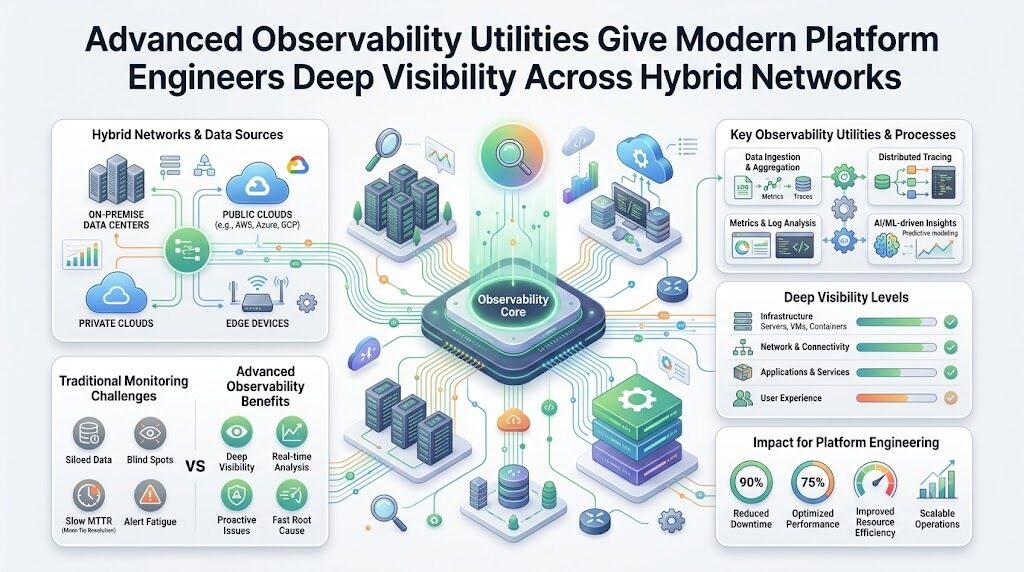
Advanced Observability Utilities Give Modern Platform Engineers Deep Visibility Across Hybrid Networks
What Is AIOps?
Artificial Intelligence for IT Operations means using smart computer programs to help human workers. We shorten this long name to AIOps. IT operations means the daily work of keeping business computers running smoothly. Computers create digital diary entries called logs. They also track performance numbers called metrics, such as memory use. Important changes trigger notices called events. Monitoring tools watch these numbers every single second. However, broken machines create too many loud alarm sounds called alerts. Smart computers use machine learning to study these alerts carefully. Machine learning teaches software to spot patterns without human help. The software then performs root-cause analysis to find the real source of trouble. Next, automation runs quick repairs without any human button clicks.
Why Do IT Teams Need AIOps?
Modern businesses run computer software inside huge cloud data centers. These large setups create millions of system data lines every minute. Human engineers quickly get tired because too many false alarms ring. Workers call this stressful problem alert fatigue. Teams waste hours trying to find small hidden bugs. Manual work slows down the entire tech support team. Broken apps make angry customers wait a very long time. Also, the same software problems repeat week after week. Teams need fast answers before total system crashes happen. Smart programs group related warnings together so engineers see the real trouble. AIOps helps workers spot bad code changes early. But smart software cannot magically fix every single computer issue. Humans must still make important business decisions.
AIOps Tasks and Benefits
| AIOps Task | Simple Meaning | Possible Benefit |
| Data Gathering | Collecting logs and numbers | Teams see all computer health in one spot. |
| Noise Reduction | Silencing duplicate false alarms | Engineers focus only on urgent system bugs. |
| Anomaly Finding | Spotting weird computer behavior | Teams catch software problems before outages occur. |
| Event Grouping | Linking related errors together | Workers understand which broken app caused other failures. |
| Auto Fixes | Running self-healing repair scripts | Machines recover fast without waiting for humans. |
What Does TheAIOps.com Offer?
Engineering teams often need clear educational material to build modern skills. TheAIOps.com provides helpful learning resources for beginners and working pros. Learners can explore structured AIOps Training to build strong operational habits. The site explains how an AIOps Course teaches modern monitoring workflows. Professionals can also prepare for an industry AIOps Certification. Organizations learn about picking the right AIOps Platform for big data. The site details practical AIOps Tools used across the software industry. Businesses can also read about AIOps Consulting and professional AIOps Services. These guides assist engineers during an active AIOps Implementation. Every future AIOps Engineer can find clear roadmaps to grow technical abilities.
AIOps Training and AIOps Course
Good technical education starts with clear fundamentals and basic concepts. Students in an AIOps Course learn how computers create event logs. They study how metric collectors measure system processor heat and speed. Next, learners practice alert management to silence unimportant status notifications. They discover how anomaly detection finds weird server spikes fast. Training teaches root-cause analysis so students can trace errors to bad code. Students also build simple scripts to test automated system restarts. Hands-on labs let people practice on real broken computer setups. Real examples show how big online shops stay online during busy holidays. Theory helps, but fixing broken practice systems builds true skill.
AIOps Learning Areas
| Learning Area | What Learners Should Practice |
| Log Analysis | Read computer error logs and find repeating error codes. |
| Metric Tracking | Graph memory, storage space, and processor speed over time. |
| Alert Filtering | Group identical alert messages so screens stay clean and readable. |
| Anomaly Detection | Set up machine models that notice unusual traffic surges. |
| Root Cause Study | Trace a failed customer purchase back to a dead database. |
| Auto Remediation | Write safe scripts that clear full disk drives automatically. |
| Cloud Networking | Connect monitoring tools across different public cloud data centers. |
| Team Workflows | Send clean alert summaries directly into team chat rooms. |
AIOps Certification and AIOps Engineer Skills
An AIOps Certification shows that an engineer understands smart operations tools. Preparing for an exam helps workers study core ideas in order. But a paper certificate alone will not guarantee a job. Companies look for practical skills and proven engineering ability. A great AIOps Engineer knows how to watch complex cloud networks. They excel at troubleshooting broken programs under heavy time pressure. They write automation scripts to eliminate boring manual tasks. These workers also understand basic data science and machine learning concepts. Furthermore, clear communication matters because engineers must explain problems to managers. Practicing on personal projects shows employers that you can solve real outages.
AIOps Tools and AIOps Platform
Engineers use specialized software to keep business networks safe and fast. Basic monitoring tools watch whether servers are turned on or off. Observability tools look deep inside running programs to find hidden delays. Log management systems collect millions of text records from every server. An integrated AIOps Platform connects all these streams into one smart brain. Incident tools notify the right engineers when serious emergencies happen. When picking AIOps Tools, companies must check their own business goals first. Teams must ensure the platform connects to existing company software easily. Leaders must review software license costs and check strict customer data security. Finally, tools must scale up easily as business operations grow larger.
AIOps Implementation: How Does It Work?
Teams should start an AIOps Implementation by picking one small, painful problem. First, gather clean operational data from servers running that single application. Connect your monitoring agents so information flows into the central hub. Next, set up rules to drop useless duplicate notifications. Train your smart software to learn normal traffic patterns across the week. Test anomaly detection so the system spots weird traffic jumps accurately. Then, link related alerts together to see root problems quickly. Build simple automation to fix tiny problems, like clearing full temp folders. Always require human approval before software restarts important financial databases. Measure your time savings carefully, improve your rules, and expand slowly.
AIOps Consulting and AIOps Services
Many large businesses hire outside experts when building smart operational systems. Professional AIOps Consulting helps companies choose the right technical approach early. Specialists deliver AIOps Services like checking current computer networks for blind spots. Consultants help leaders pick tools that fit their actual corporate budget. They also design system architecture and build reliable data connections between tools. Experienced advisors train internal staff so employees can manage systems alone. They also build safe automation rules to prevent accidental file deletions. However, companies must define clear goals before hiring external consulting agencies. Knowing your biggest operational headaches ensures you spend your budget wisely.
Real-Life Scenarios / Experiences
An online clothing shop suffered website crashes during a massive holiday flash sale. Thousands of buyers hit the checkout page at the exact same second. Their smart monitoring platform noticed the unusual memory surge within five seconds. The system added three backup servers instantly and stopped a costly crash.
A regional bank received five thousand error alerts after a routine network update. Human engineers felt overwhelmed by the flashing red screens and sirens. The smart operations tool grouped all five thousand alerts into one single event. It pointed engineers directly to one disconnected network cable in room four.
A media company had a server disk drive fill up with video logs. The smart automation system detected the low disk space warning early. It archived old video logs to secondary storage without waking any on-call engineer. The morning team arrived to find a clean server and an informational ticket.
How TheAIOps.com Can Help
Learning smart IT operations takes time, practice, and the right guides. TheAIOps.com gives engineers and business leaders clear technical information every day. You can explore structured AIOps Training to upgrade your current operational abilities. Discover how an AIOps Course helps beginners master logs, metrics, and automation. If you want to validate your skills, study our AIOps Certification materials. The site reviews popular AIOps Tools so companies choose the best software. You can also study guides on AIOps Consulting and enterprise AIOps Services. The platform explains every stage of an AIOps Implementation in plain language. Use the site to build practical skills and become a confident AIOps Engineer.
A Practical Implementation Approach
Start your project with one single application that causes regular weekend trouble. Identify the exact server logs and performance metrics needed to diagnose it. Connect those few data sources into your new analysis tool carefully. Establish clear filtering rules so normal system noise disappears from view. Next, test anomaly detection algorithms against old incident data to verify accuracy. Create your first automated fix for an easy, low-risk operational task. Always keep human approval buttons for actions that touch customer databases. Track your mean time to resolution to see how much faster repairs happen. Polish your operational steps based on weekly feedback from your system administrators. Expand your smart monitoring platform to other company systems only after proving success.
Common Mistakes to Avoid
Trying to automate every single operational task on day one causes major system errors. Many teams collect massive piles of dirty, unorganized data that confuses smart algorithms. Another mistake is buying expensive tools before defining what business problem needs solving. Teams often ignore human culture, which makes engineers fear losing their technical jobs. Relying entirely on automated scripts without human sanity checks can delete live customer data. Some organizations turn on machine learning models without testing them against old outages first. Other teams fail to train their staff, leaving fancy software unused on dashboards. Finally, leaders frequently forget to track cost savings, making future project budgets hard to justify.
Frequently Asked Questions
1. What does AIOps mean in simple words?
AIOps means using smart computer programs to help human workers manage computer systems. Computers watch system data day and night. They spot errors fast and can run automated repairs. This helps companies keep websites and mobile apps running without costly interruptions.
2. Is AIOps meant to replace human IT engineers?
No, smart operations tools do not replace human workers. They handle boring, repetitive jobs like reading huge log files. This frees engineers to design better software and solve unique bugs. Humans still make final decisions during major operational emergencies.
3. What is the difference between DevOps and AIOps?
DevOps is a team working style that helps developers and operators build software together. AIOps is a set of smart tools that use artificial intelligence on system data. Teams use smart operations tools inside their DevOps workflows to work faster.
4. Which programming languages help an AIOps Engineer most?
Python is the most popular programming language for smart IT operations today. Engineers use Python to clean log data and talk to machine learning tools. Learning basic Linux shell scripting also helps workers automate daily operating system tasks easily.
5. What are the three main types of operational data?
The three main operational data types are metrics, event logs, and network traces. Metrics show performance numbers like memory usage over time. Logs contain timestamped event notes written by software. Traces follow a single customer click across multiple computer servers.
6. Can small companies benefit from using smart IT operations?
Small companies can benefit if they run complex cloud apps that crash often. However, very small businesses with only two servers do not need machine learning. Simple free monitoring tools work fine until business network traffic grows much larger.
7. What is alert noise in computer operations?
Alert noise means hundreds of useless warning messages flooding an engineer's phone screen. Most of these messages report tiny issues that fix themselves quickly. This noise hides genuine emergencies and makes tired engineers miss critical system failures.
8. How long does a standard system rollout take?
A small rollout focused on one application usually takes three to six months. Teams need time to clean data, tune rules, and test auto fixes safely. Large global companies often spend over a year rolling software out across all departments.
9. What does root-cause analysis mean for servers?
Root-cause analysis means finding the original hidden problem that triggered other system failures. For example, a broken database might cause ten different web stores to crash. The smart tool points engineers directly to the database instead of the stores.
10. Do I need a math degree to learn these tools?
No, you do not need an advanced math degree to learn operations tools. Most commercial platforms handle the complex machine learning calculations in the background automatically. Engineers just need to know how to read charts, configure tools, and write basic scripts.
11. What is automated remediation in modern computing?
Automated remediation means computer software fixing a broken server without human help. For example, a script might restart a frozen program when memory usage hits ninety percent. This self-healing action keeps customer websites working without waking engineers at midnight.
12. How does anomaly detection help site reliability teams?
Anomaly detection learns what normal computer behavior looks like during typical business days. It notices when network traffic suddenly behaves differently than usual. This early warning lets engineers check the system before users notice broken pages.
CONCLUSION
Modern computer systems grow larger every day, and smart automation helps teams manage this heavy workload. Using artificial intelligence for system operations stops alert noise and finds hidden software bugs fast. Learning these technical methods helps engineers keep important business programs running without crashes. Beginners can practice simple scripting, study event logs, and build practical troubleshooting habits. Platforms like TheAIOps.com provide helpful guides, tool reviews, and training resources to support your learning journey. Start with small operational fixes, test your automations carefully, and keep human oversight on critical systems. With steady practice and the right foundational knowledge, any engineer can master these modern operational tools.